Free Marketing Toolkit Opt-in
(02) 42444411 info@ybrmarketing.com.au
SEO vs. PPC: Why You’re Asking the Wrong Question

SEO vs. PPC: Why You’re Asking the Wrong Question


The Coffee Shop Conundrum

Let me tell you about a client I sat down with a few months ago. She runs a brilliant little café in Marrickville, Sydney. The coffee is incredible, the fit-out is perfect, but her growth had flatlined. She knew she “needed to be online” but was completely paralysed.

“I’ve got one quote for SEO that says it’ll take six months to ‘see results,’ and another for Google Ads (PPC) that wants $3,000 a month just to get started,” she told me, completely overwhelmed. “I’ve only got a limited budget. Where do I put my money?”

This is the single most common question I get. And it’s based on a faulty premise.

The problem is that for years, you’ve been told to think of Search Engine Optimisation (SEO) and Pay-Per-Click (PPC) Advertising as a choice. They’re presented as two boxers in a ring, and you have to bet on which one will win.

I’m here to tell you to stop asking “SEO or PPC?” The real, strategic question is, “How do I use SEO and PPC together?”

Welcome to the Two-Engine Growth Strategy. It’s the framework I use to build sustainable, compounding growth machines for businesses, and it requires both engines to work.


Engine 1: The Foundation (SEO as Your Compounding Asset)

First, let’s get our terms right.

SEO is the long-term, strategic process of earning “free” traffic from search engines like Google.

Most businesses see SEO as a technical checklist of keywords and code. This is wrong.

I want you to think of SEO as a capital investment. It’s like buying digital property. When you spend $3,000 to write a high-quality expert article for your website, you aren’t “spending” that money. You are converting it from cash into an asset.

The “Snowball Effect” Most Businesses Ignore

This is the part most blogs don’t explain well. SEO has a compounding return on investment (ROI). It’s like a financial “snowball”. 

  • Month 1: You publish a brilliant, helpful article. It gets a few visitors.
  • Month 6: Google sees people are reading it. Other sites start to link to it. It moves up the rankings.
  • Year 2: That same article you paid for once, two years ago, is now on page one. It’s attracting a steady, growing stream of “free” traffic, and it has gained so much authority that it’s helping your other pages rank, too.  

This asset—your “authority library” of content—is now on your digital balance sheet, paying you dividends (in the form of leads) every single month, long after you paid for it. 

The Catch: The Cash Flow Gap

So, if SEO is so great, why not just do that?

Because of The Cash Flow Gap.

SEO is slow. Painfully slow. It often takes 6 to 12 months to see a meaningful, positive ROI. One study found the average page ranking in the top 10 is over two years old. 

As a small business owner, you can’t wait two years for the phone to ring. You have payroll next week. If you only invest in SEO, you risk running out of cash before your “snowball” ever gets big enough to matter. 


Engine 2: The Accelerator (PPC as Your Cash-Flow Tap)

This is where your second engine comes in.

PPC (Pay-Per-Click) advertising, like Google Ads, is the polar opposite of SEO. It is your controllable “tap” for speed, precision, and targeted growth.  

I want you to think of PPC as your cash-flow solution.

  • You don’t have to wait 6 months. You can launch a campaign and be at the very top of Google this afternoon.
  • You don’t have to guess. You can “bypass all the ranking factors” and get your message in front of a specific, high-intent audience right now.  
  • You get immediate, measurable data on what messages lead to conversions.

The Catch: The “Hamster Wheel” of Diminishing Returns

So, why not just pour all our money into this “tap”?

Because PPC, when used alone, is a “hamster wheel” of diminishing returns. The cost of digital advertising in Australia is only going up. You’re constantly fighting ad fatigue, rising competition, and you’re 100% reliant on your budget. 

The moment you stop paying, the tap turns off. The traffic stops. Instantly. 

Relying only on PPC is a trap. It’s how businesses “overextend yourself financially and hurt the profitability”. You’re essentially “renting” your traffic forever, and the rent always goes up. 


The Two-Engine Strategy: How You Win in the Real World

This is the core of the strategy. This is where we stop thinking and start building.

You don’t have a choice between the engines. You need both, working in harmony.

You use the PPC Accelerator to generate immediate cash flow. You then use that cash flow to fund the creation of your long-term SEO Foundation.

PPC solves SEO’s speed problem. SEO solves PPC’s cost problem.

A Real-World Tactical Example

Let’s go back to my Marrickville café owner.

  1. Week 1 (The Accelerator): We launch a small, highly-targeted PPC campaign focused only on people in her suburb searching for “best coffee near me” or “Marrickville cafe.” This immediately gets her in front of high-intent customers and starts driving revenue.  
  2. Week 2 (The Foundation): We take a portion of that new revenue and re-invest it. We write the first “pillar” article for her SEO Foundation—a “Complete Guide to Marrickville’s Best Coffee Shops.”
  3. Ongoing: The PPC campaign continues to pay the bills and generate short-term profit. The SEO “asset” starts its slow “snowball” climb up the rankings.
  4. Month 8 (The Synergy): Her SEO article is now ranking. It’s attracting “free” organic traffic. We can now reduce our PPC spend for those keywords, reallocating that budget to a new campaign (like “office catering”).  

She used the short-term rental (PPC) to fund the purchase of her long-term asset (SEO). She has successfully bridged the Cash Flow Gap.

Your New Question

Stop asking “SEO vs. PPC?”

Start asking, “How fast can my Accelerator Engine (PPC) fund my Foundation Engine (SEO)?”

That’s how you move from just surviving to building a truly sustainable, compounding growth machine.

Is your business visible to local customers on Google? use our interactive tool Find Your Local SEO Opportunity Score”

I hopes this serves you 😀
Red 

SEO vs PPC,SEO or PPC for small business,benefits of SEO and PPC together,digital marketing strategy Australia,SEO for small business,PPC for small business,SEO compounding asset,PPC diminishing returns,SEO foundation,PPC accelerator,marketing cash flow strategy,sustainable marketing growth,SEO vs PPC Australia,marketing consultant,marketing agency Australia,how much does seo cost in australia,SEO Wollongong,paid ads Wollongong,SEO vs. PPC for Wollongong Business: Why You’re Asking the Wrong Question

Where to find me: Hit me up at our Website or Social Handles 👇👇

SEO vs. SEM | Why Australian Businesses Are Getting It Wrong

SEO vs. SEM | Why Australian Businesses Are Getting It Wrong

SEO vs. SEM | The Digital Marketing Secret Every Aussie Business Owner Needs to Know

Picture this: you’ve just poured your heart, soul, and a hefty chunk of your savings into opening a brilliant little café in Melbourne. The coffee is top-notch, the smashed avo is a work of art, and the vibe is perfect. There’s just one problem. Nobody knows you exist. In the digital world, your website is that café. It can be the best on the block, but if no one can find it, you’re just serving coffee to an empty room.

Now, you’ve probably heard the buzzwords thrown around: SEO and SEM. They sound similar, and you know they have something to do with getting found on Google, which, let’s be honest, is the modern-day high street. With over 2.6 million actively trading businesses in Australia, standing out online isn’t just an advantage; it’s a necessity. Especially when you consider that a whopping 63% of Aussie consumers will simply ignore a business if they can’t find any information about it online.

The Australian digital advertising market is booming, hitting an incredible $4.2 billion in the first quarter of 2025 alone, with search advertising accounting for a massive $1.9 billion of that spend. Businesses are clearly investing heavily to get noticed. But here’s where it gets tricky. Many treat SEO and SEM like a footy derby—two fierce rivals where you have to pick a side.

This is the single biggest mistake you can make.

This article isn’t another boring blog that just defines the terms. We’re going to pull back the curtain and show you the secret that most don’t talk about: SEO and SEM aren’t rivals. They’re teammates. And when you learn how to make them play together, you don’t just get a few more website visitors. You build a powerful, sustainable engine for growth that leaves your competition scratching their heads.

Let’s Clear the Air | What Are SEO and SEM, Really?

Before we get into the game-winning strategy, let’s make sure we’re all on the same page. The jargon can be confusing, but the concepts are actually quite simple when you break them down.

SEM is the Whole Shebang

Think of Search Engine Marketing (SEM) as the entire sport of fishing. It’s the overarching term for any activity you undertake to get your website seen on a search engine like Google, which dominates the Australian market with over 91% of all searches SEM is the whole game plan.

Within this game plan, you have two primary ways to catch fish (or in our case, customers).

The Two Main Tools in Your SEM Tackle Box

1. SEO (Search Engine Optimisation) The Art of Earning Your Spot

SEO is the process of optimising your website to attract unpaid, organic traffic from search results. This is the long game. It’s like carefully choosing the perfect spot in the river, casting a wide, durable net, and patiently waiting. You’re not paying Google for every fish you catch; you’re earning them by proving you have the best fishing spot. SEO itself is made up of a few key disciplines:

  • On-Page SEO – This is about optimising the stuff on your website—crafting high-quality content, using the right keywords, and making sure your page titles and headings are clear and descriptive. 
  • Off-Page SEO – This involves activities outside of your website to build its authority and trust. The most important part is link building—getting other reputable websites to link to yours, which acts like a vote of confidence.  
  • Technical SEO – This is the behind-the-scenes work to ensure your website’s infrastructure is solid. It includes things like site speed, mobile-friendliness, and having a clean site structure so Google can easily find and understand your content.
  • Local SEO – For any business with a physical location (like our café), this is crucial. It’s about optimising your online presence to show up in location-based searches, like “best coffee near me.” A huge 93% of Australians search online for local businesses, so you can’t afford to ignore this.

2. PPC (Pay-Per-Click). The Fast Track to the Front Page

PPC is the other side of the SEM coin. This is where you pay for ad space to attract paid traffic. The most common platform for this is: 

Google Ads.

Think of PPC as using a high-tech fishing rod with the perfect bait to target a precise location where you know the fish are biting right now. You pay for the bait (the ad) and you only pay when you get a bite (a click). It’s fast, precise, and gives you immediate results.

The Need for Speed | When You Need Results Yesterday, Turn to PPC

Let’s be real. Sometimes, you don’t have time to wait for your net to fill up. You need customers now. This is where PPC shines.

Instant Gratification vs. The Slow Burn

The single biggest difference between SEO and PPC is the timeline for results. A well-crafted PPC campaign can be launched in the morning and start driving traffic to your website by the afternoon. You can literally go from invisible to the top of Google in a matter of hours.

SEO, on the other hand, is a marathon, not a sprint. It typically takes a good 6 to 12 months of consistent effort to see a significant increase in organic rankings and traffic. It’s a powerful long-term strategy, but it won’t pay this month’s rent.

The “Pay-to-Play” Model. Renting Your Spot

The speed of PPC comes with a catch: it’s a “pay-to-play” system. You are essentially renting visibility on Google. The moment you stop paying, your ads disappear, and so does your traffic. It’s a continuous operational expense.

This is why an over-reliance on PPC can be dangerous. If your entire business depends on paid ads, you’re vulnerable to rising ad costs, competitor bidding wars, or budget cuts.

When is PPC Your Best Mate?

Despite its transient nature, PPC is an incredibly powerful tool for specific, time-sensitive goals. Here’s when you should absolutely be using it:

  • New Launches and Promotions – Launching a new product, service, or a weekend sale? PPC gives you the immediate market exposure you need to generate buzz and drive initial sales.
  • Testing the Waters – This is a big one. Before you invest months into an SEO strategy, you can use a small PPC budget to test the viability of different keywords, validate market demand, or A/B test different marketing messages to see what resonates with Aussie customers.
  • Hyper-Targeting – Need to reach women aged 25-34 in a specific Sydney suburb who are interested in yoga? PPC’s granular targeting capabilities (by demographics, location, interests, etc.) are unmatched by SEO.
  • Jumping the Queue – In hyper-competitive industries (think finance or insurance), where competitors have a massive head start in SEO, PPC allows you to bypass them and get your brand on the first page from day one.

Playing the Long Game | Why SEO is Your Best Bet for Lasting Value

If PPC is like renting a flashy billboard, SEO is like buying the building it’s attached to. It’s a long-term investment that builds a durable, appreciating business asset.

Building a Digital Asset, Not Just Renting Eyeballs

The true power of SEO lies in its compounding effect. Every piece of high-quality content you create, every authoritative backlink you earn, and every technical improvement you make adds to your website’s foundational strength. This creates a “flywheel” effect where, over time, your rankings become more stable and can be maintained with less effort compared to the continuous budget required for PPC.

This creates a powerful competitive moat. A competitor can’t just throw more money at the problem to outrank you overnight. They have to undertake the same time-consuming process of building authority and trust.

The Economics of Authority, A Better ROI

Let’s be clear: SEO is not free. It requires a significant investment in time, expertise, and content creation. However, the economic model is one of investment rather than expenditure.

Over the long term, SEO consistently delivers a higher Return on Investment (ROI) and a lower Customer Acquisition Cost (CAC) than PPC. One analysis found that the average CAC from paid search was 65% higher than from organic search. As your organic traffic grows, your cost per lead effectively drops, making your business more profitable and stable.

The Trust Factor, Why Clicks Aren’t Created Equal

There’s a deep psychological difference in how users perceive paid versus organic results. We all see that little “Sponsored” tag and know it’s an ad. Organic results, however, are seen as more trustworthy and authoritative because their position has been earned through merit, not bought.

This “trust dividend” is huge. Studies consistently show that users click on organic results at a much higher rate than paid ads, with some data suggesting organic search drives 53% of all website traffic compared to just 15% from paid search. A high organic ranking is an implicit endorsement from Google itself, building brand credibility that money can’t buy.

The Secret Most Blogs Don’t Talk About | They’re Better Together

Okay, so PPC is fast and targeted, and SEO builds long-term value and trust. Most articles stop there, leaving you to pick a side. But the real magic happens when you stop thinking “versus” and start thinking “and.” Integrating SEO and PPC creates a powerful feedback loop where each one makes the other stronger.

The Ultimate Feedback Loop. How PPC Data Supercharges Your SEO

This is the part that can save you thousands of dollars and months of wasted effort. PPC is the perfect, rapid-testing lab for your long-term SEO strategy.

Test Keywords with PPC, Then Dominate with SEO

Wondering if you should spend the next six months trying to rank for “artisanal dog treats Sydney”? Instead of guessing, run a small PPC campaign targeting that keyword. Within a week, you’ll have real-world data on how many people click and, more importantly, how many convert. If a keyword proves profitable in PPC, you can then confidently invest in a long-term SEO strategy to rank for it organically, knowing you’re targeting a term that actually drives business value. 

Steal Winning Ad Copy for Your Organic Listings

Writing the perfect organic page title and meta description to entice clicks can feel like a guessing game. With PPC, you can A/B test different ad headlines and descriptions to see which ones get the highest click-through rate (CTR). Once you have a statistically proven winner, you can use that exact messaging for your organic title and meta description, dramatically increasing your organic CTR.

Find Hidden Gold in Search Query Reports

This is a pro-level tip. Your Google Ads account has a “search query report” that shows you the exact phrases people typed into Google that triggered your ad. This is an absolute goldmine for SEO. You’ll uncover new long-tail keywords, question-based queries (“how to stop my puppy from chewing shoes”), and the precise language your customers use. This is the perfect inspiration for new blog posts and FAQ pages that perfectly match user intent. 

How Good SEO Makes Your Ads Cheaper, The Quality Score Connection

This relationship is a two-way street. A strong SEO foundation directly improves the efficiency and reduces the cost of your PPC campaigns. This happens through Google’s Quality Score.

In simple terms, Quality Score is a rating from 1-10 that Google gives your ads based on their relevance and quality. A higher Quality Score leads to better ad positions at a lower cost-per-click (CPC). Two of the three main factors for Quality Score are directly improved by SEO :

1. Landing Page Experience – Google wants to send users to pages that are fast, mobile-friendly, and have high-quality, relevant content. What does that sound like? Core technical and on-page SEO! A well-optimised site naturally earns a higher landing page experience score, which boosts your Quality Score and lowers your ad costs.

2. Ad Relevance – Google checks if your keyword, ad copy, and landing page content are all aligned. A website with a clear structure and topically focused pages (both outcomes of good SEO) makes it much easier to create highly relevant ads, which again, boosts your Quality Score.

Owning the Whole Page – The Power of a Dual Presence

When you successfully integrate your strategy and appear in both the top paid ad spots and the top organic listings, you achieve “SERP (Search Engine Results Page) ownership.” This has a powerful psychological effect on users.

Seeing your brand twice acts as a “double validation”. The paid ad shows you’re a serious player, and the organic listing shows you’ve earned Google’s trust. This builds massive brand credibility. It also dramatically increases your overall clicks, as you’re taking up more of the valuable digital real estate on the first page.

So, What’s the Play for Your Aussie Business? A Simple Action Plan

The optimal strategy isn’t a one-size-fits-all solution. It depends on your business goals, budget, and timeline. Here’s a simple framework to guide you.

If You’re a New Business or Launching Something Now

Your Focus: Speed, data, and immediate leads. Your Strategy: Start with a PPC-led approach. Allocate the majority of your budget (e.g., 70%) to PPC to drive instant traffic and gather that crucial keyword and conversion data. Use the remaining 30% to build your foundational SEO—a technical audit, core keyword research, and creating essential “cornerstone” content pages.

If You’re an Established Business Looking for Sustainable Growth

Your Focus: Long-term authority, brand building, and cost-effective lead generation. Your Strategy: Transition to an SEO-dominant strategy. As your organic presence matures, SEO should become your primary engine for traffic. Your budget could shift to something like 75% SEO / 25% PPC. PPC is then used surgically for specific campaigns, defending your brand name from competitors, or targeting only the most valuable commercial keywords.

The Golden Rule for Everyone

No matter which phase you’re in, the most important thing is to stop treating SEO and PPC as separate departments. Whether it’s two different teams, two agencies, or just you wearing two different hats, you must ensure the data and insights are constantly being shared between them. Your PPC manager should be telling your SEO manager which keywords are converting, and your SEO manager should be telling your PPC manager which new content pages are ready for a paid boost.

It’s time to move beyond the “versus” debate. The smartest businesses in Australia aren’t choosing between SEO and SEM; they’re mastering the art of using SEO and PPC together. By building this symbiotic relationship, you create a digital marketing strategy that is not only more powerful and efficient but also incredibly resilient and built for the long haul.

I hopes this serves you 😀
Red 

SEO,SEM,PPC,digital marketing Australia,SEO vs SEM,paid search,organic search,digital strategy

Where to find me: Hit me up on this Website or check out our Social Handles 👇👇

Keyword Research | Your Website’s Unshakeable Foundation for Australian SEO Success

Keyword Research | Your Website’s Unshakeable Foundation for Australian SEO Success

Remember that beautiful sourdough bakery we talked about in Fairy Meadow? Imagine the owner, let’s call her Sarah, had a hunch that people in the area would love her artisanal bread. Instead of just setting up shop and hoping for the best, Sarah wisely decided to do some groundwork. She chatted with locals at the markets, asked what kind of bread they usually bought, and even checked out what other bakeries in Wollongong were offering. This real-world research is the offline equivalent of keyword research for your website.

Just like Sarah wouldn’t open her bakery without understanding her local market, you shouldn’t launch your website without understanding the digital market for your products or services. Skipping keyword research is like trying to build a magnificent skyscraper on a swampy foundation – it might look impressive at first glance, but it’s destined for trouble.

As we discussed, keyword research is the absolute bedrock of any successful SEO strategy. It’s not just a preliminary step you can gloss over; it’s the essential intelligence that informs every single decision you make about your website. Think of it as the compass guiding your entire online journey.

Let’s explore exactly why this “foundation first” approach is so crucial.

Informs Site Architecture: Building a User-Friendly and Search Engine-Optimized Structure

(Keywords: site architecture, user-friendly, search engine optimized, categories, pages, URL structure, keyword mapping)

Imagine a library. If the books were just thrown randomly onto shelves, it would be virtually impossible to find anything, right? A well-organized library has clear sections, categories, and a logical system for locating specific books. Your website’s site architecture is the same thing for your online content.

Keyword research plays a pivotal role in determining how you structure your website. By understanding the different keywords your target audience is using, you can create a logical hierarchy of pages and categories that makes sense to both your users and search engines like Google.

Here’s how it works:

  • Identifying Core Keywords: Your primary keyword research will reveal your main service areas or product categories. These will often become your top-level pages in your website’s navigation. For Sarah’s bakery, core keywords might be “sourdough bread,” “artisan bakery,” “custom cakes,” and “baking classes.” These would likely translate into the main sections of her website.
  • Uncovering Subtopics and Long-Tail Keywords: As you delve deeper into your keyword research, you’ll uncover more specific long-tail keywords – longer phrases that indicate a more specific need. These can become your subpages or blog post topics. For example, under “Baking Classes,” Sarah might have subpages for “Beginner Sourdough Workshop Fairy Meadow” and “Advanced Pastry Techniques Wollongong.”
  • Creating a Logical URL Structure: Your URL structure (the web address of each page) should also reflect your website’s hierarchy and incorporate relevant keywords. A well-structured URL is easier for both users and search engines to understand. For instance, Sarah’s beginner sourdough class page might have the URL: www.sarahsourdough.com.au/baking-classes/beginner-sourdough-workshop-fairy-meadow. This clearly indicates the page’s content and includes relevant keywords.
  • Keyword Mapping: This involves strategically assigning specific keywords to individual pages on your website. This ensures that each page has a clear focus and is optimized for the terms your target audience is most likely to use when looking for that specific information or offering.

Without this initial keyword research, you might end up with a website structure that’s based on your internal business organization rather than how your customers actually think and search. This can lead to a confusing user experience and make it difficult for search engines to understand what your different pages are about, ultimately hindering your SEO efforts.

Guides Content Creation: Answering Your Audience’s Questions with the Right Language

(Keywords: content creation, blog posts, FAQs, website copy, answering questions, user language, keyword-driven content)

Content is king in the online world, and keyword research is the map that guides your content creation journey. By understanding the keywords your audience is using, you can create content that directly addresses their questions, solves their problems, and provides the information they are actively seeking.

Think about it: if you know that people in your area are searching for “gluten-free bread options Fairy Meadow,” and you offer gluten-free bread, wouldn’t it make sense to create a dedicated page or blog post specifically about your gluten-free offerings, using that exact keyword phrase?

Here’s how keyword research informs your content:

  • Identifying Content Topics: Your keyword research will reveal the popular questions and topics related to your industry. These become excellent starting points for blog posts, articles, FAQs, and even video content. For Sarah, her research might show people are asking “how to store sourdough bread” or “best way to revive stale sourdough,” leading to valuable blog post ideas.
  • Using the Language of Your Audience: Keyword research helps you understand the specific language and terminology your target audience uses. This allows you to write website copy and create content that resonates with them and feels natural. You’ll be speaking their language, which builds trust and makes it more likely they’ll engage with your website.
  • Optimizing Existing Content: Even if you already have content on your website, keyword research can help you identify opportunities to optimize it by incorporating relevant keywords naturally into the text, headings, and meta descriptions.
  • Creating Comprehensive and Valuable Content: By targeting a range of related keywords, you can create in-depth and comprehensive content that positions you as an authority in your niche and attracts a wider audience.

Without keyword research, you might be creating content based on what you think is interesting or important, rather than what your audience is actually looking for. This can lead to content that doesn’t attract traffic or engage your target customers.

Directs On-Page Optimization: Placing Keywords Where They Matter Most

(Keywords: on-page optimisation, page titles, headings, meta descriptions, image alt text, keyword placement, search engine visibility)

Once you know your target keywords, you need to strategically incorporate them into specific elements of your website to improve its visibility in search engine results. This is known as on-page optimisation, and keyword research is the compass that guides this process.

Here are the key areas where keyword placement matters:

  • Page Titles (Title Tags): These are the clickable headlines that appear in search results and are a crucial ranking factor. Your primary keyword for each page should ideally be included in the page title, preferably towards the beginning. For Sarah’s sourdough class page, a good title might be: “Beginner Sourdough Workshop Fairy Meadow | Sarah’s Sourdough.”
  • Headings (H1, H2, H3): Headings help break up your content and make it easier to read. Your main heading (H1) should include your primary keyword, and subsequent subheadings (H2, H3, etc.) can incorporate related keywords and variations.
  • Meta Descriptions: These are short snippets of text that appear below the page title in search results. While they don’t directly impact rankings, compelling meta descriptions that include relevant keywords can encourage users to click on your link.
  • Image Alt Text: This is a description you provide for your images. It helps search engines understand what your images are about and can also improve accessibility. Use relevant keywords when describing your images. For a picture of Sarah’s sourdough bread, the alt text might be: “Freshly baked sourdough bread from Sarah’s Bakery in Fairy Meadow.”
  • Body Content: Naturally weave your target keywords throughout your page’s content. Avoid keyword stuffing (overusing keywords), as this can actually harm your rankings. Focus on creating high-quality, user-friendly content that incorporates keywords where they make sense.

By strategically placing your target keywords in these key areas, you signal to search engines what your pages are about, making it more likely they will show your website to users searching for those terms. Without knowing your keywords from your initial research, you’ll be optimizing blindly, potentially missing out on valuable opportunities to improve your search engine visibility.

(Keywords: link building, anchor text, website authority, trust, backlinks, off-page SEO)

While the weight given to specific anchor text in link building has decreased over the years, understanding your target keywords can still indirectly influence your off-page SEO efforts. Link building is the process of getting other reputable websites to link back to yours, which helps build your website’s authority and trust in the eyes of search engines.

When reaching out to other websites for potential backlinks, understanding your primary keywords can help you:

  • Identify Relevant Websites: You’ll be looking for websites in your industry or related niches that are likely to use similar terminology.
  • Suggest Relevant Anchor Text (Use with Caution): If you have some control over the anchor text used in the backlinks, you can subtly incorporate relevant keywords. However, it’s crucial to aim for natural and varied anchor text profiles to avoid looking manipulative to search engines. Focus on brand names and generic terms as well.
  • Create Linkable Assets: Your keyword research will inform the types of valuable content you create (e.g., in-depth guides, helpful resources). This high-quality content is more likely to attract backlinks naturally from other websites.

While not as direct as it once was, the underlying understanding of your target keywords still plays a role in your overall link building strategy and helps you build a network of authoritative backlinks to your website.

The Non-Negotiable First Step

(Keywords: non-negotiable, first step, website success, SEO foundation, informed decisions)

Ultimately, keyword research isn’t just a task to tick off a list; it’s the non-negotiable first step towards building a successful website that attracts organic traffic and achieves your business goals. It provides the essential foundation upon which your entire SEO strategy is built.

By understanding what your potential customers are searching for, you can make informed decisions about your website’s structure, content, and optimisation. You’ll be building a website that speaks directly to the needs and interests of your target audience, making it more likely they will find you, engage with your content, and ultimately become your customers.

So, before you even think about the colour of your buttons or the layout of your homepage, take the time to delve into the world of keyword research. It’s an investment that will pay dividends in the long run, ensuring that your beautiful new website doesn’t just sit silently in the digital desert but instead becomes a thriving hub for your business.

References:

The Australian SMB Digital Surf Guide

The Australian SMB Digital Surf Guide

Your Playbook for Dominating the Online Marketplace

Keyword Strategy Generator

Enter your business type and location to generate a list of targeted keywords for your Australian business.

Local Keyword Mixer

Select common modifiers to generate more specific local keyword ideas.

Your Keyword Opportunities

Strategic Guides

1. Competitive Reconnaissance

Identify your true digital competitors by searching for your main keywords. Use SEO tools (even free tiers) to see what keywords they rank for and which of their pages attract the most traffic.

Action: Find their high-performing keywords and look for strategic gaps they aren't covering.

2. Find Content Gaps

Look for questions your audience is asking that your competitors aren't answering well. This is your chance to become the go-to resource.

Action: Create high-quality content (blog posts, videos, guides) that fills these gaps. Think about different formats, not just text.

3. Master Local SEO

Your Google Business Profile (GBP) is critical. Keep it updated with accurate info, photos, and encourage reviews. Use hyper-local keywords including suburbs and landmarks.

Action: Fully optimize your GBP today. Brainstorm keywords with local suburb names (e.g., "bakery Fairy Meadow," not just "bakery Wollongong").

Which SEO Tool is Right for You?

Answer these three questions to get a tailored recommendation.

What's your monthly SEO tool budget?

How's your technical SEO expertise?

What's your primary goal?

© Digital Surf Guide. Built to help Australian small businesses thrive online.

This tool provides suggestions based on SEO best practices. For deep analysis, consider using a dedicated SEO platform.

Stop guessing and start strategizing. Use our free Digital Surf Guide above to generate a tailored list of high-impact keywords for your Australian business in under 30 seconds. It’s fast, free, and built for you.

I hope this serves ya,

Keyword Research,Your Website's Unshakeable Foundation for Australian SEO Success,Keyword Research | Your Website's Unshakeable Foundation for Australian SEO Success Red 

Need a hand? Drop us a Line 📞 🗝 (02) 42444411

Follow Us on Social ⏬⏬

Decoding Google’s Secret Sauce – SEO Success Factors That Truly Matter

Decoding Google’s Secret Sauce – SEO Success Factors That Truly Matter

Let’s start with a little story. Imagine you’re a detective, hot on the trail of a mysterious case. You’ve got fragments of clues, whispers from informants, and a hunch that something big is going on. That’s kind of like figuring out Google’s search algorithm. It’s complex, ever-changing, and shrouded in a bit of mystery. But just like any good detective, we can still crack the case, or at least get pretty close.

Here’s a sobering fact to set the stage: In Australia, as of January 2025, Google held a staggering 94.44% of the search engine market share. That means if your business isn’t showing up in Google searches, you’re practically invisible to the vast majority of your potential customers. It is, therefore, in your best interest to optimise your site for Google. And to do this, we need to understand what Google wants. It’s not just about ticking off boxes; it’s about understanding the bigger picture. While there are over 200 known and suspected ranking factors, obsessing over each one is like trying to catch every grain of sand on Bondi Beach – overwhelming and ultimately pointless. Instead, we need to focus on the SEO success factors that truly move the needle.

Understanding SEO Success Factors vs. Ranking Factors

Let’s clear up some terminology. Many people use “ranking factors” and “success factors” interchangeably, but there’s a subtle yet important difference.

What are Ranking Factors?

Ranking factors are the specific elements that Google directly considers when determining a webpage’s position in search results. These are things like keyword usage in title tags, page loading speed, and the number of quality backlinks. These are your bread and butter, the concrete elements you can directly influence.

What are Success Factors?

SEO success factors, on the other hand, are a broader category. They encompass both direct ranking factors and elements that indirectly influence your SEO performance. Think of them as the supporting cast that helps your main actors (ranking factors) shine.

A success factor might not get you a starring role in the search results on its own, but it can be the crucial element that gets you noticed by the casting director (Google). For example, having a user-friendly website design isn’t a direct ranking factor, but it can lead to lower bounce rates and longer time spent on your site – signals that Google does pay attention to.

The Enigma Machine – Machine Learning and SEO

Here’s where things get really interesting. In the early days of SEO, it was a bit like a game of checkers – relatively straightforward and predictable. You could identify specific ranking factors, optimize for them, and see fairly predictable results. But then came machine learning, and the game changed to something more akin to 4D chess.

Google’s algorithms, powered by machine learning, are now incredibly sophisticated. They learn, adapt, and evolve at an astonishing pace. This means that what worked yesterday might not work today, and what works for one website might not work for another.

10 years of Google algorithm updates
Source: Moz.com

The Black Box Effect

This complexity has led to what some SEOs call the “black box effect.” Essentially, it means that even Google engineers may not fully understand every nuance of how their algorithms interact and determine rankings. There are so many variables, so many connections, that it’s impossible to trace the exact path from input to output.

This doesn’t mean we should throw our hands up in despair. It just means we need to be more strategic.

Prioritizing Your SEO Efforts – Don’t Sweat the Small Stuff

With so many potential factors to consider, it’s easy to get lost in the weeds. You could spend weeks tweaking your website’s code to improve page speed by a fraction of a second, or agonizing over the perfect keyword density. But are those efforts really going to make a significant impact? Probably not.

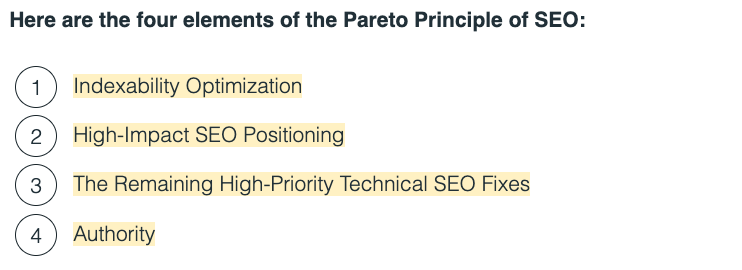
The 80/20 Rule of SEO

Instead, it is essential to focus on the critical success factors that deliver substantial results. This is the 80/20 rule in action; 80% of your results will come from 20% of your efforts.

80/20 principle in SEO
Source: Intergrowth

Your time and resources are limited. Don’t waste them chasing after negligible ranking signals that will have little to no impact on your overall SEO performance. Instead, identify the heavy hitters – the factors that can truly boost your visibility and drive organic traffic.

The Meta Description Mystery – Not a Ranking Factor, But Still Important

Here’s a classic example of a success factor that’s often misunderstood: meta descriptions.

What is a Meta Description?

A meta description is the short snippet of text that appears under your page title in search results. It’s your chance to summarize your page’s content and entice users to click through.

meta description example

Now, here’s the key: Google has stated that meta descriptions are not a direct ranking factor. That’s right, the exact words you use in your meta description won’t directly influence where your page ranks.

The CTR Connection

However, a well-written, compelling meta description can significantly improve your click-through rate (CTR). This means more people who see your listing in search results will actually click on it.

And here’s where it gets interesting: While Google claims that they don’t use CTR data directly in their ranking algorithms, many SEO experts, me included :D, believe that a higher CTR can send positive signals to Google. Think of it like this: if a lot of people are clicking on your result, it suggests that your page is relevant and valuable to users searching for that particular query. While not officially confirmed, this is a case where indirect factors can be just as powerful.

Aggregated Analysis of SEO Success Factors – The Wisdom of the Crowd

So, how do we identify these critical SEO success factors? It’s not just guesswork. We have a wealth of information at our disposal, gathered from a variety of sources:

1. Ranking Factor Studies

Many reputable SEO organizations conduct large-scale studies, analyzing millions of search results to identify correlations between specific factors and higher rankings. These studies provide valuable data-driven insights.

2. SEO Experimentation Data

SEO professionals are constantly experimenting, testing different strategies and tactics to see what works. This collective experimentation data, shared within the community, helps us understand the real-world impact of various SEO factors.

3. Expert Opinion Surveys

Surveys of experienced SEO practitioners provide valuable insights into what they’ve found to be most effective in their work. These surveys often reveal emerging trends and best practices.

4. Patent Filings

Google files numerous patents related to search technology. While these patents don’t always reflect current practices, they can offer clues about the direction Google is heading and the factors they consider important.

5. Statements from Google

Google representatives, like John Mueller and Gary Illyes, often share information about how their algorithms work through blog posts, webmaster hangouts, and social media. While they don’t reveal all the secrets, these statements provide valuable guidance.

By combining insights from these various sources, we can create a comprehensive picture of the SEO success factors that truly matter.

Actionable Steps for SEO Improvement – Start with the Big Rocks

Knowing is half the battle; the other half is doing. Here’s how to put this knowledge into action;

1. Prioritize the Critical Factors

Don’t try to tackle everything at once. Start with the most impactful factors – the “big rocks” that will yield the greatest results. These typically include things like:

  • High-Quality Content; Creating valuable, informative, and engaging content that satisfies user intent is paramount.
  • Technical SEO; Ensuring your website is technically sound, with fast loading times, mobile-friendliness, and a clear site structure.
  • Backlinks: Earning high-quality backlinks from authoritative websites is still a major ranking factor.
  • User Experience (UX): Providing a positive user experience is crucial, as Google prioritizes websites that are easy to use and navigate.


2. Progressively Address Less Important Elements

Once you’ve addressed the critical factors, you can gradually work your way down to the less important elements. This might involve optimizing images, refining your internal linking structure, or improving your social media presence. Each little factor will improve your SEO performance as a whole.

3. Monitor and Adapt

SEO is an ongoing process. Regularly monitor your website’s performance, track your rankings, and analyze your traffic data. Be prepared to adapt your strategy as needed based on your findings and changes in Google’s algorithms.

Visual Resource – Your SEO Success Factor Cheat Sheet

To make things even easier, I’ve created a high-resolution graphic that summarizes the key SEO success factors discussed in this article. Feel free to download it, print it out, and keep it handy as you work on your SEO strategy. Please remember to attribute the graphic back to this article if you use it elsewhere. This is an excellent resource to keep by your desk so you always have an overview of what is important.

Next Steps – Dive Deeper into the SEO Checklist

This article has provided a broad overview of SEO success factors. But if you’re ready to take your SEO game to the next level, I encourage you to dive deeper into our Template 085: [Downloadable] The SEO Checklist. [This is a dedicated resource where we provide, detailed explanations, actionable tips, and real-world examples for each of these crucial factors. You can do this by signing up to our newsletter, where we provide monthly updates on Google’s algorithm and more.]

Primary Reference Sources

To ensure the accuracy and credibility of this information, I’ve relied on a variety of reputable sources, including:

  • Moz: www.moz.com – A leading authority on SEO, providing tools, resources, and research.
  • Search Engine Journal: www.searchenginejournal.com – A comprehensive news site covering all aspects of search marketing.
  • Search Engine Land: www.searchengineland.com – Another leading news site dedicated to search engine marketing.
  • Backlinko: www.backlinko.com – Known for in-depth guides and case studies on SEO.
  • Google Search Central: developers.google.com/search – Google’s official resource for webmasters, providing guidelines and best practices.
  • Ahrefs: An industry-leading SEO toolset with an informative blog.

Focus on What Matters

In the ever-evolving world of SEO, it’s easy to get lost in the noise. There are countless articles, videos, and tools vying for your attention, often promising quick fixes and magical solutions. But the truth is, successful SEO is about focusing on the fundamentals – the impactful success factors that truly make a difference.

By understanding the distinction between ranking factors and success factors, prioritizing your efforts, and staying informed about the latest trends, you can develop a winning SEO strategy that drives organic traffic, improves your visibility, and ultimately helps you achieve your business goals. So, go forth, focus on what matters, and watch your SEO performance soar. Remember, it’s not about chasing every shiny object; it’s about making smart, strategic choices that deliver long-term results. Good luck on your SEO journey, and feel free to reach out in the comments if you have any questions or want to share your own SEO success stories!

I hopes this serves you 😀
Red 

Decoding Google's Secret Sauce - SEO Success Factors That Truly Matter,SEO success factors,Google ranking factors,SEO tips for Australian businesses,improve website ranking,content quality,technical SEO,mobile optimization,local SEO Australia,Google My Business.

Where to find me: Hit me up at our Website or Social Handles 👇👇

Call Now Button