Free Marketing Toolkit Opt-in
(02) 42444411 info@ybrmarketing.com.au
The Business Owner’s Guide to Tracking Marketing ROI (Without the Jargon)

The Business Owner’s Guide to Tracking Marketing ROI (Without the Jargon)

The Data Black Hole | Why Your Aussie Marketing Attribution is Broken (And How to Fix It)

The Tuesday Morning Panic

It’s Tuesday morning in Surry Hills. Sarah, a Marketing Manager for a booming e-commerce brand, sits down with her flat white and opens her analytics dashboard.

On the surface, everything looks… okay. Sales are coming in. But there’s a nagging problem. Her boss just walked in and asked for a breakdown of exactly which campaign drove the $50k spike in revenue last month. Sarah looks at Google Analytics 4 (GA4), and it’s staring back at her with a shrug. The dreaded “Direct” traffic source is claiming credit for 40% of her sales.

She knows that’s a lie. People didn’t just wake up, telepathically divine her brand’s URL, and type it in. They saw a TikTok, or a friend WhatsApped them a link, or they saw a digital billboard on the way to work. But the data says “Direct.”

Sarah is flying blind. And if you’re running a business in Australia right now, chances are, you are too.

Attribution—the science of assigning credit to marketing touchpoints—has gone from being a “fuzzy” science to a fragmented mess. Between the upcoming changes to the Australian Privacy Act, the rise of “Dark Social” (we love our Messenger groups down here), and AI eating up search traffic, the old playbook of “last-click” attribution is officially dead.

In this guide, we’re going to look at the blind spots most blogs won’t tell you about, specifically tailored for the Australian landscape, and give you the practical tools to turn the lights back on.


🧠 The Jargon Buster | A Cheat Sheet for Non-Marketers

Before we dive into the deep end, let’s pause. Marketing loves an acronym, and nothing alienates a business owner faster than a sentence full of three-letter words.

If you’ve ever nodded along in a meeting while secretly Googling terms under the table, this section is for you. Here is a plain-English translation of the concepts we are about to discuss:

1. Attribution

  • The Textbook Definition – The process of identifying a set of user actions across screens and touchpoints that contribute to a desired outcome.

  • The Real Talk – It’s the “Blame Game,” but for good things. When a sale happens, Attribution is simply deciding which ad, email, or post gets the credit for it. If you spend $100 on Facebook and get a sale, attribution is the tool that tells you, “Good job, Facebook did that.”

2. Walled Gardens

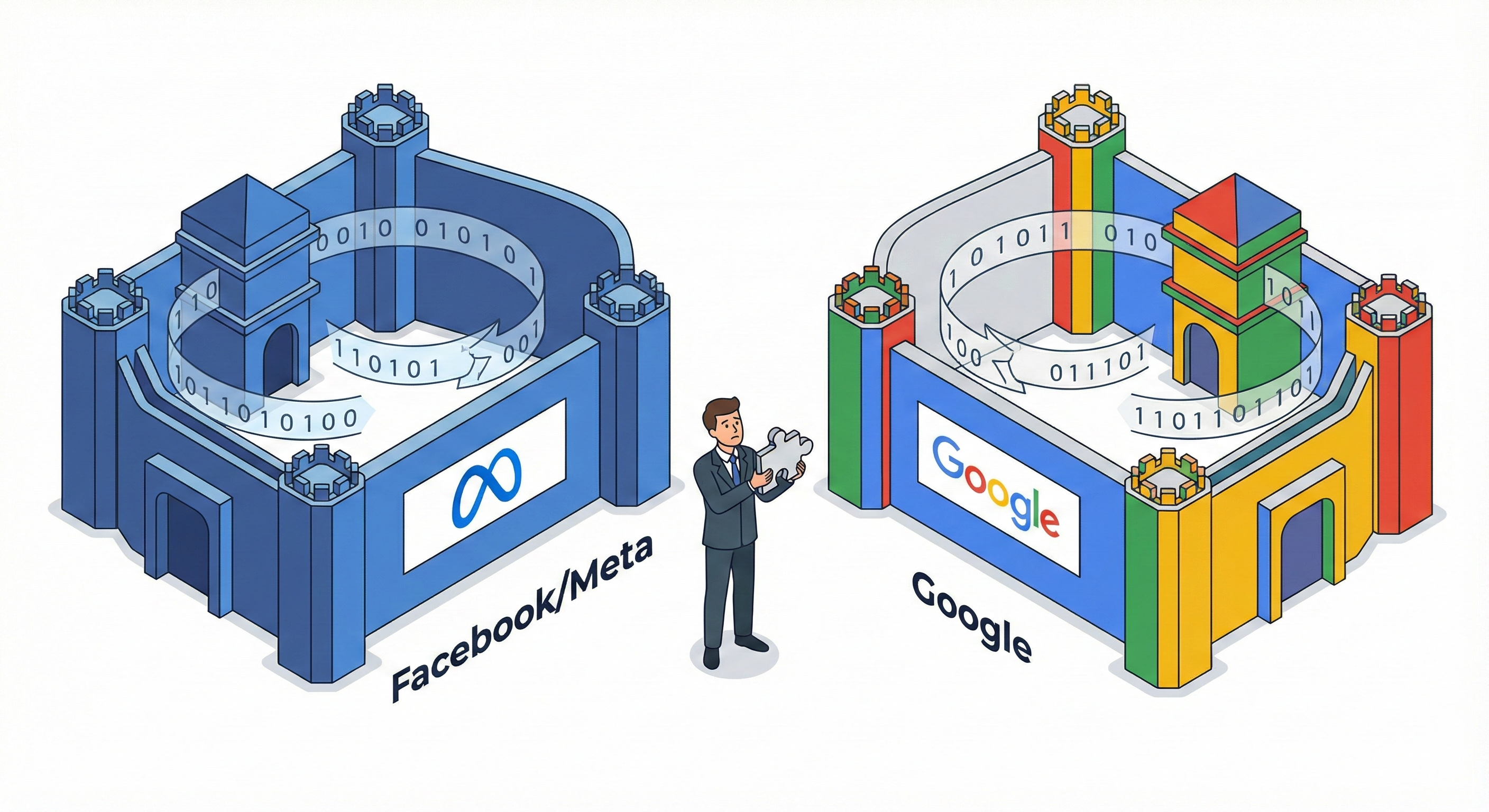
  • The Real Talk – Think of platforms like Facebook, Google, and Amazon as private clubs. They let you come in and put up posters (ads), but they don’t let you take their guest list (data) home with you. They keep their data behind high walls to force you to keep paying them for access. They don’t share information with each other, which creates gaps in your tracking.

How Google and Meta trap data and don't share it with each other.

3. Dark Social

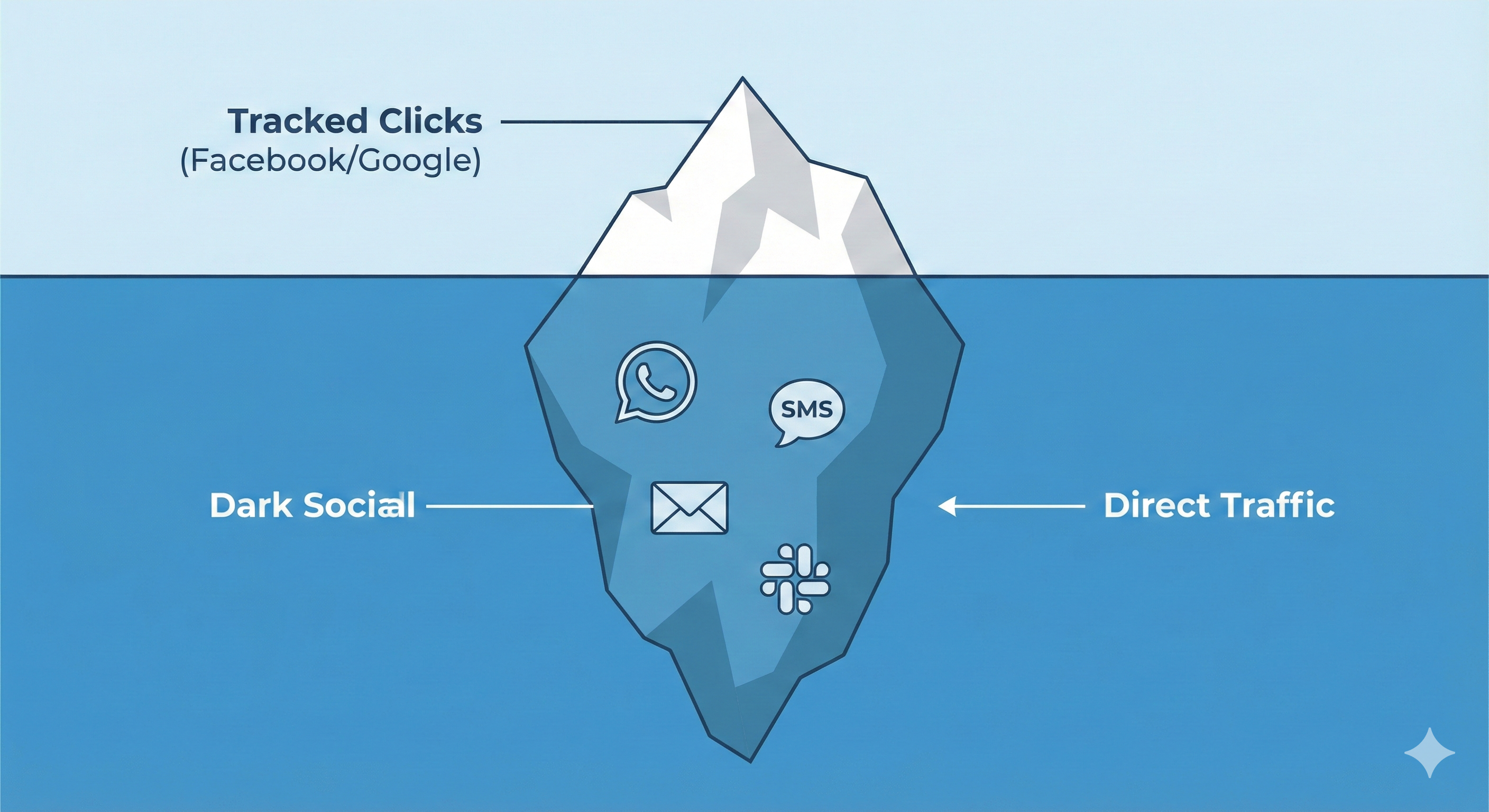
  • The Real Talk – This sounds ominous, but it just means “invisible sharing.” It’s when someone copies a link and texts it to a friend via WhatsApp, SMS, or email. Tracking tools can’t see inside private messages, so the traffic looks like it came from nowhere (the “dark”).

How most sharing happens privately (WhatsApp) where you can't see it.

4. ROPO (Research Online, Purchase Offline)

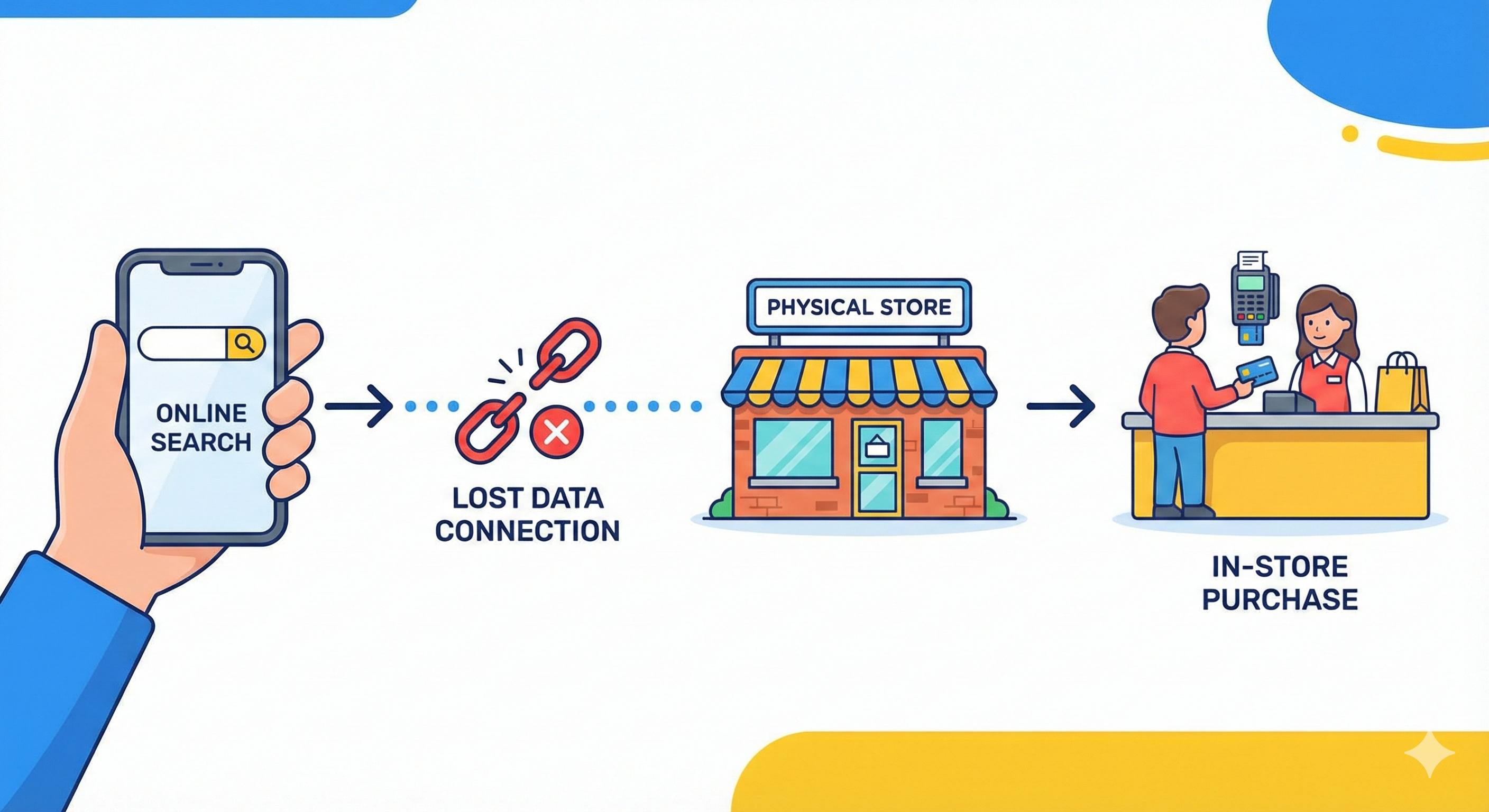
  • The Real Talk – The classic Aussie shopper habit. You look up a new 4WD accessory on your phone while sitting on the couch, but you drive to the store to buy it so you can have it today. The digital ad did the work, but the physical store got the money—and the digital team gets zero credit.

The disconnect between phone searching and store buying.

5. Conversion

  • The Real Talk – The moment the window shopper becomes a buyer. It’s not just a sale; it could be filling out a “Contact Us” form, downloading a brochure, or booking a demo. It is the ultimate goal you want the customer to hit.


The “Flying Blind” Reality | Why It’s Scary

Historically, marketers relied on a simple chain of events: Customer clicks ad > Customer buys product > Ad gets credit.

That world is gone.

In 2024, the Australian internet advertising market grew by 11.1% to reach $16.4 billion. That is a massive amount of money being poured into digital channels. Yet, as spending goes up, visibility is going down. We are dealing with privacy constraints, zero-click searches, and those “walled gardens” we just defined.

If you are still relying on a simple dashboard to tell you where to spend that $16.4 billion, you might be optimising for the wrong things entirely.

The “Black Box” Problem

Platforms like Google and Meta have automated their ad delivery so aggressively that they’ve removed the levers we used to pull. According to recent industry analysis, there are over 90% fewer optimisation permutations in Google and Meta Ads today compared to just two years ago.

You put money in, the algorithm does “something,” and (hopefully) sales come out. But you don’t know why. This is dangerous because when sales stop, you won’t know what broke.


The Major Blind Spots (And Why They Matter in Aus) 

Let’s get specific. You might be staring at your dashboard and missing huge chunks of the customer journey. Here are the biggest culprits that are eating your data.

1. The Walled Gardens (The Giants Don’t Share) 

You rent space on their platforms, but they own the data. If a user sees an ad on Instagram (Meta) but converts later on a desktop search (Google), Meta will claim the credit in their reporting, and Google will claim the credit in theirs.

  • The Result: You might be double-counting conversions. You think your ROI is amazing because both Facebook and Google are taking credit for the same sale. In reality, you’re paying twice to acquire the one customer.

2. The Aussie “Dark Social” Obsession

This is the silent killer of attribution data in Australia. Australians are massive adopters of private messaging, perhaps more so than other markets where public Twitter/X usage is higher.

  • Facebook Messenger: Used by 68.9% of Aussie social media users.

  • WhatsApp: Used by 48.3% and growing fast for business communications.

The Scenario – I see a cool pair of boots on Instagram. I don’t buy them. Instead, I copy the link and paste it into my WhatsApp group chat with my mates, saying, “Thoughts?” My mate clicks the link and buys them. To your analytics software, this looks like “Direct” traffic. There is no “referrer” tag from WhatsApp. The attribution trail is cold. You think my mate is a loyal brand fan who typed in your URL; actually, he’s a cold lead referred by a social ad you paid for.

3. The Offline/Online Disconnect (ROPO)

“Research Online, Purchase Offline” is standard behavior in Australia, especially with our high concentration of physical retail dominance (think Bunnings, JB Hi-Fi, or Mecca).

A customer might click your Google Ad on their mobile while on the bus, browse your catalogue, and then walk into your store in Westfield Bondi Junction to buy it with cash or card.

  • The Blind Spot: Your CRM records a sale. Your Google Ads dashboard records a “wasted” click with no conversion. You might turn off that profitable ad campaign because the data says it’s not working, inadvertently killing your foot traffic.

4. The Looming “Under-16” Data Void

Here is a uniquely Australian curveball: The government has passed legislation to ban social media for children under 16, effective late 2025.

While the primary goal is mental health protection, the marketing implication is a massive, sudden loss of data. If you market to teens (or even products for teens bought by parents), a huge demographic is about to vanish from digital targeting and attribution pools entirely. They will still be consuming media (likely shifting to YouTube, streaming services, or gaming), but the pixel-based tracking you rely on via Instagram or TikTok will evaporate for this cohort.


The Unspoken Truths | What Most Blogs Won’t Tell You

Most articles stop at “cookies are going away.” But the rabbit hole goes deeper.

The “Zero-Click” Phenomenon

Google is trying to answer user queries on the search results page. With AI Overviews (formerly SGE: Search Generative Experience), users can get their answer about your service without ever visiting your website.

  • The Impact: Your “organic traffic” metrics might tank, but your brand awareness could still be high. If you only measure success by “website sessions,” you’ll think your SEO is failing. You need to start measuring Share of Search or brand mentions, not just clicks.

The “Stacking” Effect

The scariest part isn’t one of these blind spots—it’s when they stack.

Imagine a user journey like this:

  1. Sees your ad on a Connected TV (CTV) – Untracked.
  2. Asks ChatGPT about your brand – Untracked (LLM traffic).
  3. Gets a link sent via WhatsApp from a friend – Dark Social (looks like Direct).
  4. Walks into a store to buy – Offline Sale.

In this scenario, your digital marketing team gets literally zero credit for a sale they entirely orchestrated. The business owner sees “marketing spend” with “no return,” while the sales team takes all the glory. This leads to budget cuts that hurt the business.


Strategies to Fix the Mess (The “How-To”) 

Okay, enough doom and gloom. How do we fix it? We need to move from “Deterministic” attribution (exact tracking) to “Probabilistic” attribution (smart modeling).

1. Implement Marketing Mix Modeling (MMM)

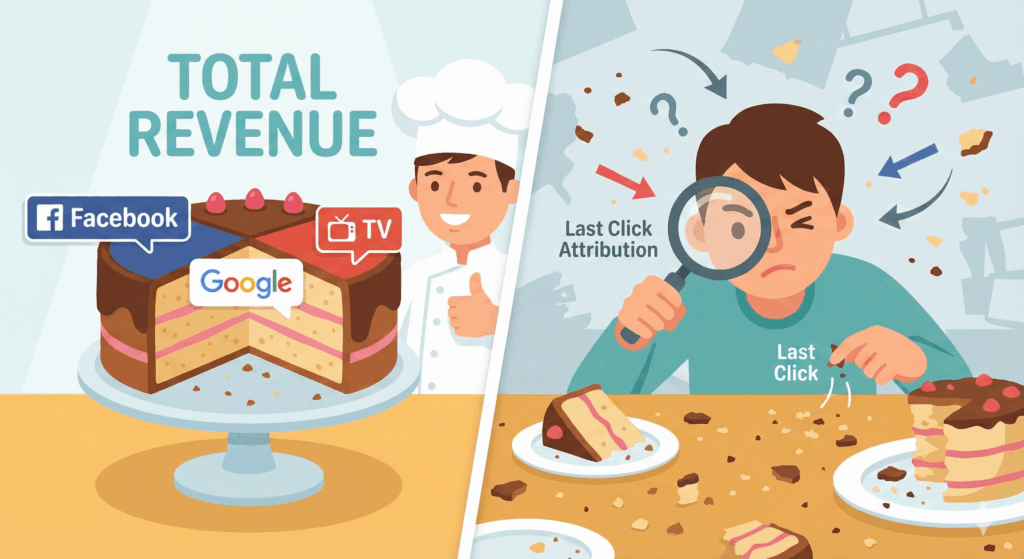
Marketing Mix Modeling (baking a cake vs. counting crumbs)

Don’t let the fancy name scare you. MMM is just statistical analysis to estimate the impact of various marketing tactics on sales.

The Cake Analogy: Think of your revenue like baking a cake. You put in flour, eggs, sugar, and chocolate (your marketing channels). The cake tastes great (Sales).

  • Touch-based attribution tries to ask the cake crumb, “Did you come from the egg or the flour?” (Impossible).

  • MMM says, “Last time we doubled the sugar, the cake got sweeter. So sugar drives sweetness.”

You don’t need a math PhD. Tools like Cassandra or even simplified spreadsheets can help you run basic correlation analyses. If you spend more on Facebook in November and sales go up in December (accounting for seasonality), there’s a correlation.

2. First-Party Data is Your Lifeboat

With the Privacy Act reforms looming in 2025, owning your data is non-negotiable. You cannot rely on third-party cookies or Facebook’s audience data.

  • The Fix: Incentivise users to give you their email/phone number early in the process. Use “quizzes,” “exclusive drops,” or “content unlocks” (lead magnets).

  • Clean Your CRM: Ensure your internal data is the source of truth. Feed this “offline conversion” data back into Google and Meta using tools like Google Enhanced Conversions or Meta Conversions API. This helps their algorithms “see” the sales they missed.

3. The “How Did You Hear About Us?” (HDYHAU) Survey

It sounds painfully old school, but it is the #1 killer of Dark Social blind spots.

Add a post-purchase survey on your “Thank You” page. Keep it required, but give open-ended options or a comprehensive list (e.g., “TikTok,” “Friend recommended,” “Podcast”).

  • Why it works: A customer will tell you, “I saw you on TikTok,” even if the tracking pixel said they came from “Google Organic.” Trust the customer; they know their own journey better than a confused robot does.

4. Create “Trap Doors” for Dark Social

If you know people are sharing links in WhatsApp, make those links trackable.

  • Strategy: Don’t just share a generic link. Use unique coupon codes for different channels. If the code “INSTA20” is used, you know it came from Instagram, even if the traffic source says “Direct.”

5. Track “AI Referrers”

People are discovering brands via ChatGPT and Perplexity. By default, this traffic often gets lumped into “Referral” or “Direct.”

  • The Fix: Create custom channel groups in GA4 for “Conversational AI.” Look for referrers like chatgpt.com or bing.com (specifically the chat interface). Segmenting this out will show you if the robots are actually your best salespeople.


Linking Attribution to Business Outcomes | The Metrics That Matter

Finally, stop trying to be perfect. You will never track 100% of the customer journey again. That era is over.

Instead, focus on Directional Accuracy. This simply means you don’t need to know the exact dollar figure every ad produced; you just need to know if the arrow is pointing up or down.

Forget the vanity metrics like “likes” or “impressions.” Here are the three numbers you should actually care about in 2025, explained in plain English.

1. MER (Marketing Efficiency Ratio)

  • What it is: Total Revenue ÷ Total Ad Spend.

  • In English: For every $1 you put into the marketing machine, how many dollars came back out?

  • Why it matters: This is your “North Star” metric because it looks at the whole picture, ignoring whether Facebook or Google claims the credit. If you spend $1,000 across all channels and make $5,000 in total revenue, your MER is 5.0. Simple. It tells you if the business is healthy.

2. CAC (Customer Acquisition Cost)

  • What it is: Total Ad Spend ÷ Number of New Customers.

  • In English: How much cash do you have to hand over to “buy” a new customer?

  • Why it matters: If you sell a coffee subscription for $20, but you spend $100 on ads to get one person to buy it, your CAC is $100 and you’re in trouble. If you spend $100 to get a client worth $5,000, you’re winning. This keeps your profitability in check.

3. Incrementality

  • What it is: The measure of “lift” or true impact.

  • In English: Would this sale have happened anyway?

  • Why it matters: If a customer was already typing your website name into Google, and you showed them an ad, you paid for a customer you already had. Incrementality measures the extra sales that wouldn’t have existed without that specific ad.

  • How to test it: Turn off ads in one state (like Queensland) or other geo-location for two weeks and see if sales drop compared to NSW or other area. That drop is your “incremental” value.


So Finally 

The “blind spots” in marketing aren’t going away; they are becoming part of the landscape. The Australian market, with its specific privacy laws and heavy reliance on social messaging, is a particularly tricky terrain.

But here is the good news; Your competitors are likely ignoring this. They are still staring at GA4, scratching their heads about “Direct” traffic, and turning off high-performing awareness campaigns because the “last click” didn’t show a sale.

By embracing a mix of First-Party Data, MMM, and good old-fashioned Customer Surveys, you can build a system that sees through the fog. You don’t need perfect data to make smart decisions—you just need better data than the other guy.

So, close the spreadsheet, go talk to your customers, and start measuring what actually moves the needle.


References:

  • IAB Australia Internet Advertising Revenue Report (2024)

  • Neil Patel: Marketing Attribution Blind Spots

  • Australian Government: Privacy Act Review Report

  • Genroe: Social Media Statistics for Australia

I hope this serves ya,

marketing attribution Australia,attribution blind spots,dark social meaning,marketing efficiency ratio explained,ROPO Australia,Privacy Act 2025 marketing,digital marketing ROI,GA4 for business owners.,The Business Owner’s Guide to Tracking Marketing ROI (Without the Jargon) Red 

Need a hand? Drop us a Line 📞 🗝 (02) 42444411

Follow Us on Social ⏬⏬
10 Marketing Tips to Thrive in 2025

10 Marketing Tips to Thrive in 2025

Picture this: It’s 2025, and marketing feels more like a chess match than a sprint. AI is rewriting emails, your competitors are experimenting with augmented reality ads, and platforms you’ve never heard of are suddenly generating massive engagement. Welcome to the future of marketing.

In Australia, digital ad spending is projected to reach $14 billion by 2025, with businesses increasingly prioritizing personalization and innovation. But here’s the kicker: While many marketers will double down on generic strategies, the real winners will be those who dare to stand out. This guide isn’t about rehashing common advice; it’s about sharing creative, actionable, and often overlooked strategies to ensure your marketing stands tall in 2025.


1. Embrace Negative Reviews

Why Negative Reviews Can Build Trust

Negative reviews can feel like a gut punch, but here’s the reality: Consumers trust brands with a mix of reviews more than those with a perfect score. A study by BrightLocal found that 85% of consumers believe online reviews with flaws are more authentic.

Actionable Steps:

  • Highlight Imperfection: Share balanced reviews on your website and social channels to show transparency.
  • Respond Thoughtfully: Address negative reviews professionally and show steps you’re taking to improve. This fosters credibility.
  • Turn Feedback Into Content: Use common complaints to create blog posts or videos explaining how you’ve addressed these issues.

Example:

An Australian skincare brand shared user feedback highlighting both positive and critical experiences. Their honesty led to a 30% increase in conversions, proving that trust drives sales.


2. Create What AI Can’t

Standing Out in a Sea of AI Content

With AI tools like ChatGPT generating generic articles and ads, standing out requires producing content that only humans can create—original studies, brand storytelling, and unique perspectives.

Actionable Steps:

  • Conduct Surveys: Run surveys with your audience and publish the results as industry insights.
  • Build Emotional Stories: Share behind-the-scenes stories of your brand or customers. Emotional resonance can’t be faked by AI.
  • Collaborate with Creatives: Work with writers, videographers, and designers to create high-quality, original content.

Example:

A Sydney-based fitness studio produced a video series featuring real client transformations. The authenticity helped them attract a 200% increase in engagement on Instagram.


3. Think Beyond Blogs for SEO

Expanding Your SEO Horizons

Blogs have long dominated SEO strategies, but in 2025, smart marketers are targeting platforms where people naturally search: TikTok, Reddit, and niche forums. TikTok SEO, for example, is growing, with users treating it like a search engine for product recommendations.

Actionable Steps:

  • TikTok Keywords: Use trending hashtags and phrases in video captions to rank for niche queries.
  • Reddit Communities: Engage in discussions and provide value without hard-selling.
  • Visual SEO: Optimize video and image descriptions for Google and social platforms.

Example:

An Australian travel agency posted TikTok videos titled “Hidden Beaches in Sydney.” These videos ranked for local searches, driving 20% more traffic to their website.


4. Empower Internal Influencers

Turning Employees Into Brand Ambassadors

In 2025, brands that leverage employee voices will humanize their messaging and create deeper connections. After all, people trust people more than they trust brands.

Actionable Steps:

  • Social Media Spotlights: Encourage employees to share their work experiences on LinkedIn or Instagram.
  • Employee Advocacy Programs: Provide incentives for employees to promote the brand online.
  • Content Takeovers: Allow team members to “take over” your brand’s social accounts for a day.

Example:

A Melbourne-based tech startup launched an “Employee Spotlight” series on LinkedIn. The posts boosted job applications by 50% and improved brand perception.


5. Diversify Marketing Channels

Exploring New Platforms

Sticking to the same platforms year after year can limit your reach. In 2025, brands need to explore emerging spaces like BeReal or AR-enhanced shopping apps to tap into fresh audiences.

Actionable Steps:

  • Experiment With New Apps: Set aside a portion of your budget to test platforms gaining traction with your target audience.
  • Monitor Trends: Use tools like Google Trends to identify emerging channels.
  • Adapt Quickly: Create content tailored to the quirks of each platform.

Example:

A Brisbane-based café gained 10,000 followers on BeReal by sharing authentic, unfiltered behind-the-scenes content.


6. Train AI to Reflect Your Brand Voice

Consistency in an Automated World

As AI tools become integral to marketing workflows, ensuring they reflect your unique tone is key. Without customization, AI risks producing generic or tone-deaf messages.

Actionable Steps:

  • Set Guidelines: Train AI models with examples of your preferred tone and phrasing.
  • Audit Outputs: Regularly review AI-generated content to ensure quality and brand alignment.
  • Blend Human Oversight: Pair AI efficiency with human creativity for the best results.

Example:

An Australian fashion retailer trained AI to write emails in their playful, quirky style. This personalization led to higher open rates compared to generic AI emails.


7. Focus on Problem-Solving Content

Becoming a Resource, Not Just a Brand

Content that solves problems builds trust and loyalty. When people see your brand as a helpful resource, they’re more likely to choose your products or services.

Actionable Steps:

  • FAQs That Go Deep: Create detailed, useful answers to common customer questions.
  • Video Tutorials: Show how to use your products or services effectively.
  • Interactive Tools: Develop calculators, quizzes, or checklists that provide immediate value.

Example:

An Australian real estate agency built a “Mortgage Calculator” tool that became their website’s top driver of leads.


8. Build a Marketing Moat with Customer Insights

Outpacing Competitors Through Data

A “marketing moat” is your competitive edge—something competitors can’t easily replicate. In 2025, that moat will be your deep understanding of customer behavior.

Actionable Steps:

  • Conduct Interviews: Speak directly to customers to uncover insights beyond data points.
  • Segment Deeply: Use data to create hyper-targeted campaigns for specific audience segments.
  • Personalize Experiences: Use insights to tailor every interaction, from emails to ads.

Example:

A Canberra-based fitness app segmented users based on activity levels, resulting in higher retention rates.


9. Break Through Selective Attention

Standing Out in a Crowded Space

With shorter attention spans, creating impactful, attention-grabbing content is critical. Bold visuals, clear CTAs, and interactive elements can help.

Actionable Steps:

  • Start Strong: Hook audiences in the first three seconds with bold visuals or questions.
  • Interactive Campaigns: Use polls, quizzes, or gamification to engage users.
  • Prioritize Clarity: Avoid overcrowding ads or landing pages; keep the message simple and direct.

Example:

An Australian charity used a quiz-based campaign to drive donations, boosting engagement by 60%.


10. Incorporate Negative Space in Campaigns

The Art of Minimalist Design

Negative space (or white space) isn’t wasted space—it’s an opportunity to focus attention. Clean, uncluttered designs improve comprehension and engagement.

Actionable Steps:

  • Focus on One CTA: Avoid overwhelming users with multiple competing actions.
  • Simplify Layouts: Use negative space to draw attention to key elements like headlines or buttons.
  • Test Designs: A/B test different layouts to find the most effective balance.

Example:

An Australian fintech app redesigned their homepage to feature one bold CTA, improving conversions by 25%.


2025 isn’t just about adapting; it’s about thriving. The brands that succeed will be those that innovate, connect authentically, and provide real value. From leveraging negative reviews to embracing minimalist design, these strategies will ensure your marketing stands out in an increasingly crowded space.

Ready to take the leap? Start implementing these tips today, and watch your brand thrive in the marketing landscape of tomorrow.

I hope this serves you,

10 Marketing Tips to Thrive in 2025,marketing tips 2025,AI marketing tools,content marketing strategies,omnichannel marketing,SEO trends 2025,Australian digital marketing,social media marketing trends,personalized marketing strategies,emerging marketing platforms,problem-solving content creation Red 

Drop us a Line 📞 🗝 (02) 42444411

Follow Us on Social ⏬⏬
Facebook Ads, Pro Tips for Maximising Results

Facebook Ads, Pro Tips for Maximising Results

Facebook Ads: Pro Tips for Maximising Results

The Power of Facebook Ads

Year after year, Facebook ads prove to be a valuable investment for digital marketers. They consistently deliver lower cost-per-click and cost-per-lead compared to other platforms like Google Ads. However, it’s easy to overspend due to the abundance of customisation and targeting options.

To help you make the most of Facebook ads, we’ve gathered insights from experienced professionals. These tips have delivered real-world results like higher click-through rates, lower costs, and more conversions. Let’s dive in!

1. Embrace “Ugly” Ads

People have become adept at recognizing and ignoring polished ads. “Ugly ads” – those resembling native content – bypass this filter. They appear organic and are more likely to grab attention, according to eCom Growth Advisor, Alexandra Greifeld.

2. Prioritise People Over Products

Ann-Marie Burrage, owner of Purple Octopus, tripled an already impressive ROAS for a butcher chain by featuring people in their ads. She emphasised that Facebook is a social platform, not just an advertising one.

Their initial ads with static product images yielded a 4:1 return on ad spend. By switching to a video featuring a team member talking about a product pack, they built trust and connected with their ideal customer.

To implement this strategy, Ann-Marie advises:

  • Know your target audience: Understand their needs and pain points.
  • Understand the buyer’s journey: Tailor your campaigns to guide them through the funnel.
  • Test continuously: Experiment with audiences, creatives, and text at different stages.

Additionally, keep text short and include five-star reviews when possible to build trust.

3. Master Data Management

Privacy concerns and data protection policies have impacted ad targeting. Ann-Marie recommends these steps:

  • Prioritise first-party data: Build customer data platforms and use lead generation forms within Facebook to collect data directly.
  • Don’t rely solely on Meta’s analytics: Cross-check with your website’s sales data due to potential discrepancies.
  • Use data to enhance sales and service: Share lead data with your team for quick follow-up using tools like Zapier.

4. Leverage Facebook’s Dynamic Ad Features

Jordan Bucknell, Founder and CEO of Upbeat Agency, suggests using Dynamic Creative Optimisation (DCO) and Advantage+ creative.

DCO dynamically tests different combinations of headlines, images, and calls to action to identify the best performers, resulting in increased click-through rates and engagement.

Advantage+ creative automatically adjusts ad elements for enhanced engagement, leading to higher conversion rates and improved ROAS.

Remember to monitor ad frequency and set caps to prevent ad fatigue.

5. Implement the “Engagement; Purchase; Scale” Method

Ashley Rodriquez, a Facebook ad coach, utilizes a three-step campaign structure:

  1. Engagement campaign: Warm up the audience with content like client reviews, results, offers, or guarantees.
  2. Purchase campaign: Retarget engaged users with ads optimized for purchases to reach those most likely to buy.
  3. Scale: Build a lookalike audience based on the original list and increase the budget to reach new customers.

6. Trust the Algorithms

Tyler Mask, Senior Manager at LocaliQ, highlights that Meta’s algorithms have improved, reducing the need for overly detailed targeting. Focus on A/B testing creative and messaging to ensure your ads resonate with the audience.

Avoid overwhelming the algorithm with too many ad sets and ads. Well-thought-out A/B testing benefits both Meta’s AI and your decision-making.

7. Utilise the Conversion Setting for Lead Ads

Mat Wendler, Manager at LocaliQ, recommends using the Conversion setting for Lead Ads to drive leads to your website forms instead of relying on Facebook lead forms. This often results in higher-quality leads and allows you to further engage visitors on your website.

Connect with Your Audience

Facebook ads remain a powerful tool, but success lies in connecting with your audience authentically and testing strategically. If you need assistance, don’t hesitate to reach out to experts for guidance. Remember, the key is to focus on building relationships and delivering value through your ads. 

And there you have it, folks! A whirlwind tour through the dynamic world of Facebook Ads. I hope this piece has sparked some new ideas, challenged a few assumptions, or simply left you feeling a bit more informed. Remember, the journey of learning and growth is never-ending. So keep exploring, keep questioning, and most importantly, keep creating.

Until next time, stay curious and stay inspired.

Wishing you epic wins,

Pro Tips for Maximising Results,advertising strategies,dynamic creative optimization,conversion optimization,ad fatigue,engagement campaigns,ROAS Red/ Marketer with a Soul

Drop us a Line 📞 🗝 (o2) 42444411

Follow Us on Social ⏬⏬
10 Must-Have Free Tools for Your First Year in Business

10 Must-Have Free Tools for Your First Year in Business

Let’s Take A Look At The Essential Free Business Tools for Your First Year

Starting your own business is an exhilarating journey, filled with dreams, ambitions, and a fair share of challenges. Imagine this: you’ve just launched your dream startup in Wollongong, and you’re navigating through the bustling Australian market. The excitement is palpable, but so is the pressure. According to the Australian Bureau of Statistics, almost About 20% of Australian new businesses fail their first year, then 60% go belly up within their first three years. These numbers fluctuate greatly based on their sector.  For cash-strapped startups, finding the right tools that are both effective and free can be a game-changer. In this article, we’ll explore ten essential free tools that can streamline your operations, boost productivity, and set you up for success in your first year.

1. Business Plan Software

The Foundation of Your Business

A solid business plan is the backbone of any successful venture. It outlines your goals, strategies, and the roadmap to achieving them. But writing a business plan can be daunting without the right guidance.

Top Pick: Score Business Plan Template

Score Business Plan Template offers a free, comprehensive template that helps you organise your business plan efficiently.

Benefits

  • Structured Planning: Helps you organise your ideas and strategies coherently.
  • Easy-to-Use Template: Save time with a professional template tailored to different industries.
  • Financial Forecasting: Provides tools to project revenue, expenses, and cash flow.

Insider Tip

Customise the template to reflect your unique business personality. Incorporate local market insights, especially if you’re targeting specific regions in Australia.

2. Accounting and Invoicing Software

Keeping Your Finances in Check

Managing finances is crucial, and as a new business owner, you can’t afford to let this slip. Proper accounting ensures you know where your money is going and helps you stay compliant with tax regulations.

Top Pick: Wave

Wave is a free accounting and invoicing software that offers comprehensive solutions for small businesses.

Benefits

  • Automates Invoicing: Ensures timely billing and follow-ups.
  • Tracks Expenses: Keeps all your receipts and expenses organised.
  • Simplifies Tax Preparation: Makes end-of-year tax filing a breeze.

Cost: Free (Optional add-ons: Payments, Payroll starting from approx. AUD 20/month)

Insider Tip

Regularly review your financial reports to spot trends and adjust your strategies. For example, if your expenses are consistently higher in a particular month, investigate why and find ways to cut costs.

3. Project Management Tools

Staying Organised and On Track

With numerous tasks and deadlines, project management tools help keep everything under control. They ensure you or your team are on the same page and nothing slips through the cracks.

Top Pick: Trello

Trello offers a free version that is highly effective for project management and team collaboration.

Benefits

  • Task Management: Break down projects into manageable tasks.
  • Team Collaboration: Keep everyone informed and engaged.
  • Deadline Tracking: Ensure projects stay on schedule.

Cost: Free (Optional Business Class upgrade approx. AUD 13.50/month per user)

Insider Tip

Use Trello to not only manage tasks but also to set up routine check-ins and feedback loops within your team. This fosters accountability and continuous improvement within your team.

4. Customer Relationship Management (CRM) Software

Building Strong Customer Relationships

In your first year, building a loyal customer base is paramount. CRM software helps manage customer interactions and data, ensuring you provide a personalised experience that keeps them coming back.

Top Pick: HubSpot CRM

HubSpot CRM offers a robust free version that caters to small businesses.

Benefits

  • Centralises Customer Information: Keep track of all customer interactions in one place.
  • Improves Customer Service: Access to detailed customer histories ensures better support.
  • Boosts Sales: Helps identify potential leads and automate follow-ups.

Cost: Free (Optional add-ons: Marketing, Sales, and Service Hubs starting from approx. AUD 65/month)

Insider Tip

Leverage CRM data to create personalised marketing campaigns. For instance, if you notice a customer frequently purchases a certain product, send them tailored promotions and recommendations.

5. Marketing Automation Tools

Streamlining Your Marketing Efforts

Marketing is crucial for growth, but it can be time-consuming. Marketing automation tools handle repetitive tasks, allowing you to focus on strategy and creativity.

Top Pick: Mailerlite (Free Plan)

Mailerlite offers a free plan that includes essential marketing automation features for startups.

Benefits

  • Email Marketing: Create, send, and track email campaigns effortlessly.
  • Automated Workflows: Set up triggers and actions for personalised customer journeys.
  • Analytics and Reporting: Measure the success of your campaigns and optimise them.

Cost: Free (Optional upgrades starting from approx. AUD 15/month)

Insider Tip

Experiment with A/B testing for your email campaigns. Small tweaks in subject lines or content can significantly impact open and conversion rates.

6. Social Media Management Tools

Harnessing the Power of Social Media

Social media is a powerful tool for building your brand and engaging with customers. However, managing multiple platforms can be overwhelming.

Top Pick: Agropulse (Free Plan)

Agropulse offers a free plan that helps you schedule posts and track engagement across various social media channels.

Benefits

  • Schedule Posts: Plan your social media calendar in advance.
  • Track Engagement: Monitor likes, shares, comments, and overall reach.
  • Analyse Performance: Gain insights into what works and what doesn’t.

Cost: Free (Optional Pro plan starting from approx. AUD 21/month)

Insider Tip

Use Agropulse to not only post content but also to engage with your audience. Responding to comments and messages promptly builds a loyal community around your brand.

7. E-commerce Platforms

Selling Online Made Easy

If your business involves selling products, an e-commerce platform is essential. It simplifies the process of setting up an online store and managing sales.

Top Pick: WooCommerce

WooCommerce is a free, open-source e-commerce plugin for WordPress that offers extensive features to get your online store up and running. N.B. Will need a WordPress website.

Benefits

  • Easy Store Setup: User-friendly interfaces to set up your store quickly.
  • Secure Transactions: Ensure safe and secure payment processing.
  • Inventory Management: Keep track of your stock levels and manage orders efficiently.

Cost: Free (Optional extensions vary, averaging approx. AUD 10-$100)

Insider Tip

Optimise your product descriptions with relevant keywords to improve search engine rankings. High-quality images and detailed descriptions, set up payment gateways etc, you can also enhance the shopping experience and reduce return rates.

8. Communication and Collaboration Tools

Enhancing Team Communication

Effective communication is key to a productive team. These tools facilitate seamless communication and collaboration, whether your team is in the same office or working remotely.

Top Pick: Slack (Free Plan)

Slack offers a free plan that is ideal for small teams needing real-time messaging, file sharing, and video conferencing.

Benefits

  • Real-Time Messaging: Instant communication with your team.
  • File Sharing: Share documents and collaborate on them in real time.
  • Video Conferencing: Hold virtual meetings and stay connected.

Cost: Free (Optional Standard plan starting from approx. AUD 10/month per user)

Insider Tip

Set up dedicated channels for different projects or departments. This keeps conversations organised and ensures everyone has access to relevant information.

9. File Storage and Sharing Services

Keeping Your Files Safe and Accessible

Cloud storage solutions are a must for any business. They ensure your files are secure, backed up, and accessible from anywhere.

Top Pick: Google Drive (Free Plan)

Google Drive offers 15GB of free storage, along with collaborative features.

Benefits

  • Cloud Storage: Access your files from any device with an internet connection.
  • Easy File Sharing: Share files with team members and clients effortlessly.
  • Document Collaboration: Work on documents simultaneously with your team.

Cost: Free (Optional Google One plans starting from approx. AUD 2.50/month for 100GB)

Insider Tip

Organise your files into clearly labeled folders and subfolders. This not only makes it easier to find documents but also ensures that everyone on your team can quickly locate the files they need.

10. Analytics and Reporting Tools

Making Data-Driven Decisions

Understanding your business data is crucial for making informed decisions. Analytics tools provide insights into various aspects of your operations, from website traffic to sales performance.

Top Pick: Google Analytics

Google Analytics is a free tool that provides powerful insights into your website traffic and user behavior.

Benefits

  • Website Traffic Analysis: Understand where your visitors are coming from and what they’re doing on your site.
  • Performance Insights: Track key performance indicators (KPIs) to gauge your business health.
  • Data Visualisation: Create intuitive charts and graphs to present your data clearly.

Cost: Free

Insider Tip

Set up custom dashboards to monitor your most important metrics at a glance. Regularly reviewing these dashboards can help you spot trends and make proactive adjustments to your strategy.

So There You Have It!

Equipping your business with the right tools, free or otherwise in the first year can set you up for success and help you navigate the challenges of entrepreneurship. Assess your specific needs, choose tools that fit your business model, and don’t be afraid to invest in quality solutions when you’re able. By leveraging these tools, you’ll be better prepared to manage your operations, engage with customers, and drive growth.

Additional Tips

Evaluating and Choosing Tools

When selecting tools, consider the following:

  • Scalability: Choose tools that can grow with your business.
  • Integration: Ensure the tools can integrate with each other for seamless workflows.
  • Cost: Balance functionality with affordability, especially in the early stages.

Scalability

As your business grows, your needs will evolve. Opt for tools that offer scalable plans, so you can upgrade features as needed without having to switch platforms.

We hope this guide helps you navigate your first year in business with confidence. Don’t forget to subscribe for more tips and guides on managing your business effectively. Download our Business Tools checklist of the tools mentioned for easy reference and start your journey to success today!

Wishing you epic business wins,

free business tools,tools for startups,free tools for small business,essential startup tools,best free business software,free accounting software,free project management tools,free CRM software,business plan software free,free tools for entrepreneurs,free tools for new business,top free tools for startups,startup success tools,free business resources,business tools first year,must-have free business tools,free e-commerce platforms,free social media tools,free collaboration tools,10 Must-Have Free Tools for Your First Year in Business Red 

Drop us a Line 📞 🗝 1300 902 588

Follow Us on Social ⏬⏬

E-commerce Neuromarketing: Boost Sales

E-commerce Neuromarketing: Boost Sales

Boost Your Ecommerce Store Sales with Neuromarketing

Hey there, e-commerce gurus! If you’re like most Aussie businesses, you’re probably always looking for an edge to boost your online sales. Let’s face it, Aussies are savvy shoppers. According to a 2023 study, 88% of us shop online, and we’re pretty good at sniffing out a deal – or a dud. So, how do you make your e-commerce store stand out in this competitive landscape? Well, there’s a secret weapon you might not know about: neuromarketing.

What the Heck is Neuromarketing, Anyway?

Neuromarketing is basically the science of how the brain responds to marketing stimuli. It’s about understanding what really makes customers tick, not just what they say they like. And it’s changing the game for online retailers who are willing to ditch outdated marketing tactics and embrace the power of brain science.

Think about it this way: traditional marketing is like asking someone what they want for dinner. Neuromarketing is like peeking into their fridge to see what they actually crave. It’s a deeper understanding of your customers’ desires, fears, and motivations, and using that knowledge to create an online shopping experience that resonates on a subconscious level.

So, How Can Neuromarketing Skyrocket Your E-commerce Sales?

Glad you asked! Let’s dive into the neuroscience behind buying decisions, explore some cutting-edge techniques, and uncover the secrets to building an irresistible online store.

Understanding the Neuroscience Behind Buying Decisions

The Brain’s Hidden Shopping List

Have you ever wondered why some products fly off the virtual shelves while others languish in the digital dust? It all comes down to how our brains work. When we shop online, we’re not just making rational decisions based on price and features. We’re influenced by a whole host of unconscious factors, including:

  • Emotions: Ever added something to your cart on a whim, only to regret it later? Yep, that’s your emotions at play.
  • Cognitive Biases: We’re wired to take mental shortcuts, like assuming a higher price means better quality.
  • Social Proof: We’re more likely to buy something if we see others doing it. FOMO (fear of missing out) is a real thing.

Neuromarketing helps you understand these hidden drivers and leverage them to your advantage.

The Power of the Unconscious Mind

Here’s a mind-blowing fact: up to 95% of our purchase decisions are made subconsciously. That’s right, your logical mind is often just along for the ride! Neuromarketing tools like EEG (electroencephalography) and fMRI (functional magnetic resonance imaging) allow us to peek into this unconscious world and see what truly influences consumer behavior.

By understanding the subconscious cues that drive purchasing decisions, you can design your e-commerce store and marketing campaigns to tap into those powerful emotions and biases.

Key Neuromarketing Techniques for E-commerce

Visual Design: Eye Candy for the Brain

Your website’s visual design is more than just aesthetics. It’s a powerful tool for influencing behavior. Here are a few neuromarketing tips to optimize your visuals:

  • Colors: Choose colors that evoke the right emotions. For example, blue conveys trust, while orange encourages action.
  • Images: Use high-quality images of people using your products. This taps into our mirror neurons, which make us more likely to imitate what we see.
  • Visual Hierarchy: Guide the eye towards important elements like the “Buy Now” button.

Pricing Strategies: The Psychology of Money

Pricing is a delicate dance between maximising profit and appealing to customers. Neuromarketing can help you find the sweet spot.

  • Charm Pricing: Ending prices in .99 or .95 can make them seem more affordable.
  • Price Anchoring: Show a higher “original” price next to the sale price to make the discount seem more significant.
  • Bundling: Offer product bundles to increase perceived value

Copywriting and Messaging: Speak to the Subconscious

Your website copy and marketing messages should do more than just inform. They should persuade and entice.

  • Emotional Language: Use words that evoke emotions like excitement, curiosity, and fear of missing out.
  • Storytelling: Weave a compelling narrative around your brand and products.
  • Social Proof: Showcase customer testimonials and reviews.

User Experience (UX): The Path of Least Resistance

Make your website easy and enjoyable to use. This means:

  • Fast Load Times: Slow-loading pages are a major turnoff for customers.
  • Intuitive Navigation: Make it easy for customers to find what they’re looking for.
  • Mobile Optimisation: Most online shopping happens on mobile devices, so make sure your site is mobile-friendly

Measuring and Optimizing Neuromarketing Efforts

You can’t improve what you don’t measure. Here are some ways to track the effectiveness of your neuromarketing efforts:

  • Eye Tracking: See where customers are looking on your website. (Hotjar Heat mapping)
  • EEG (Electroencephalography): Measure brain activity to see how customers react to your marketing materials.
  • Implicit Association Tests (IATs): Uncover unconscious attitudes and associations.
  • A/B Testing: Compare the performance of different versions of your website or marketing campaigns

By analysing this data, you can fine-tune your strategies and maximise your ROI. (Reture On Investment)

Ethical Considerations in Neuromarketing

As with any powerful tool, neuromarketing should be used responsibly. Avoid manipulating customers or exploiting their vulnerabilities. Transparency is key – be upfront about how you’re using neuromarketing techniques.

Getting Started with Neuromarketing

Ready to try neuromarketing? Here are a few ways to get started:

  • Hire a Consultant: If you’re serious about it, consider partnering with a neuromarketing expert who can guide you through the process.
  • DIY Neuromarketing: There are several affordable tools available that allow you to conduct basic neuromarketing research on your own.
  • Learn More: Read books and articles, attend workshops, and stay up-to-date on the latest research in neuromarketing

Final Thought

Neuromarketing is a powerful tool that can transform your e-commerce business. By understanding the neuroscience behind buying decisions, you can create a more engaging and effective online shopping experience that drives sales and builds customer loyalty.

Remember, neuromarketing is an ongoing process of learning and optimisation. Start small, experiment with different techniques, and track your results.

Ready to start your neuromarketing journey? 

Resource: “Emotional Marketing: The Key To Unlocking Your Consumers Hearts and Wallets”

Wishing you epic wins,

E-commerce Neuromarketing: Boost Sales,e-commerce,online sales,brain science,website optimization,customer behavior,persuasive design,pricing strategies,website optimisation,conversion rate optimisation,conversion rate optimisation specialist Red/ Marketer with a Soul

Drop us a Line 📞 🗝 1300 902 588

Follow Us on Social ⏬⏬

Call Now Button