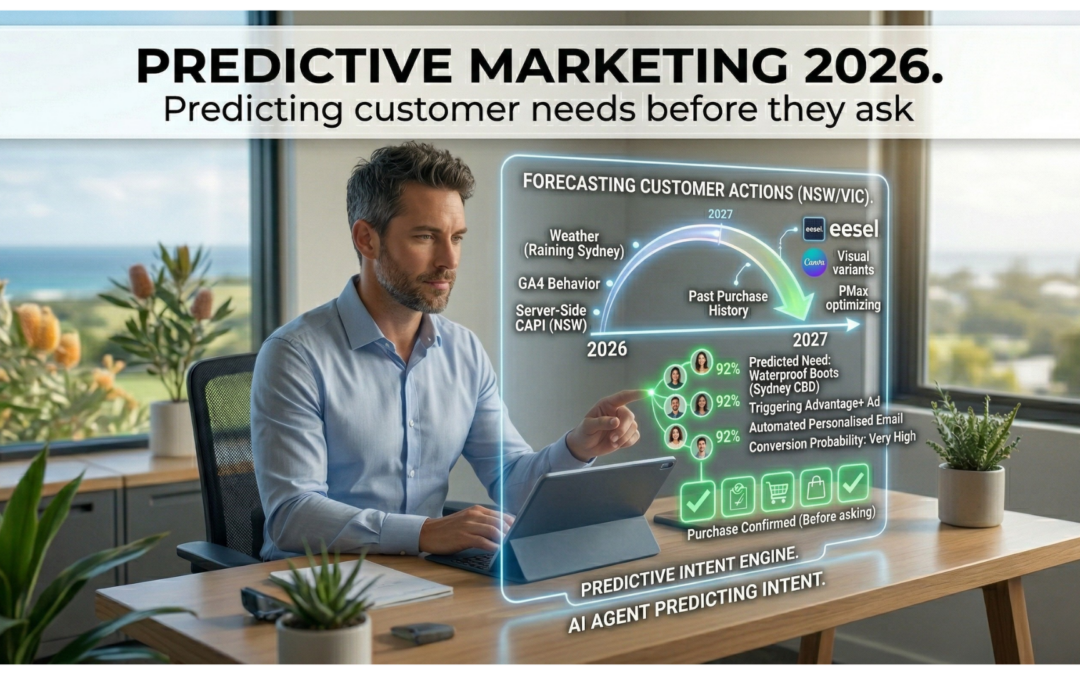
Predictive Marketing 2026 | How to Predict Customer Needs Before They Ask
Predictive Marketing – Knowing What Your Customer Wants Before They Do
In 2026, the leading Australian startups have shifted from reactive marketing (waiting for a search) to proactive marketing. This is the era of Agentic Commerce, where AI models predict intent before a customer even types a query.
However, for the DIY business owner, this “set and forget” power comes with a caveat. The very automation that makes Meta Advantage+ and Google Performance Max (PMax) so effective also makes them vulnerable to Invalid Traffic (IVT).
The Powerhouse Tools of 2026: Pros & Cons
To win in 2026, you need to understand the “High-Risk, High-Reward” nature of these automated engines.
1. Google Performance Max (PMax)
PMax uses AI to find customers across all of Google’s “surfaces” (Search, YouTube, Gmail, Maps, and Display).
-
The Pros: Incredible scale. It finds customers in places you’d never think to look. It’s perfect for the “Marketing Team of One” who doesn’t have time to manage five different campaign types.
-
The Cons (The IVT Risk): Because PMax “pools” inventory, it often pulls from the Google Display Network and Video Partners, which in 2026 have an average IVT rate of over 12-20%. Bots love these placements.
-
The 2026 Fix: Use Campaign-Level Negative Keywords and immediately exclude “Made-for-Advertising” (MFA) sites and mobile app placements.
This forces the AI to spend your budget on high-intent Search and YouTube inventory instead.
2. Meta Advantage+ (A+)
Meta’s AI-led system for Facebook and Instagram. It removes manual targeting in favor of “broad” discovery.
-
The Pros: It is arguably the best “discovery engine” ever built. It uses predictive modeling to show your product to people based on their mood and behavior, not just their interests.
-
The Cons (The IVT Risk): “Click-to-Messenger” or “Lead Form” bots. Highly sophisticated AI agents now exist to “scrape” social ads and trigger fake leads to drain competitor budgets.
-
The 2026 Fix: Switch to Server-Side Tracking (CAPI).
By validating the lead on your server before it’s reported back to Meta, you “teach” the AI to ignore the bots and only optimise for real human conversions.
The 2026 “Predictive” Comparison Table
| Feature | Meta Advantage+ | Google Performance Max |
| Best For | Visual discovery & brand scaling | Capturing multi-channel intent |
| IVT Sensitivity | High (Lead-gen bots/Social scrapers) | Moderate (Inherited from Display/GVP) |
| Transparency | Low (Minimal placement control) | Moderate (Improved reporting in 2026) |
| Aussie Edge | Great for “Community” feel | Best for “Local Service” visibility |
3 Ways to “Harden” Your 2026 Ad Spend
- Stop Bidding for “Clicks”: In 2026, a click is cheap and often fake. Always optimise for Deep Conversions (e.g., “Purchase” or “Qualified Lead”) rather than “Website Visits.” This tells the AI that you don’t care about traffic—you care about revenue.
- Use “Human-in-the-Loop” Verification: If you’re using lead forms, add one “Human Only” question that requires a specific Aussie context (e.g., “What is your suburb’s postcode?”). Modern bots can solve CAPTCHAs, but they often struggle with specific, localised logic.
- The 72-Hour Rule: AI engines need data to learn. If you see a spike in suspicious traffic, don’t panic and turn it off instantly. Give the platform 72 hours to “self-correct” using its own internal IVT filters. If it doesn’t, manually exclude the offending placements.
The Bottom Line
Predictive marketing is your “Sword”—it’s how you grow. IVT protection is your “Shield”—it’s how you survive. By using Meta Advantage+ and PMax with your eyes wide open, you can enjoy the benefits of a global-scale marketing team while keeping your DIY budget safe from the bots.