Free Marketing Toolkit Opt-in
(02) 42444411 info@ybrmarketing.com.au
AEO Guide 2026 | How to Optimise for AI Answer Engines in Australia

AEO Guide 2026 | How to Optimise for AI Answer Engines in Australia

Answer Engine Optimisation” (AEO) – The New SEO

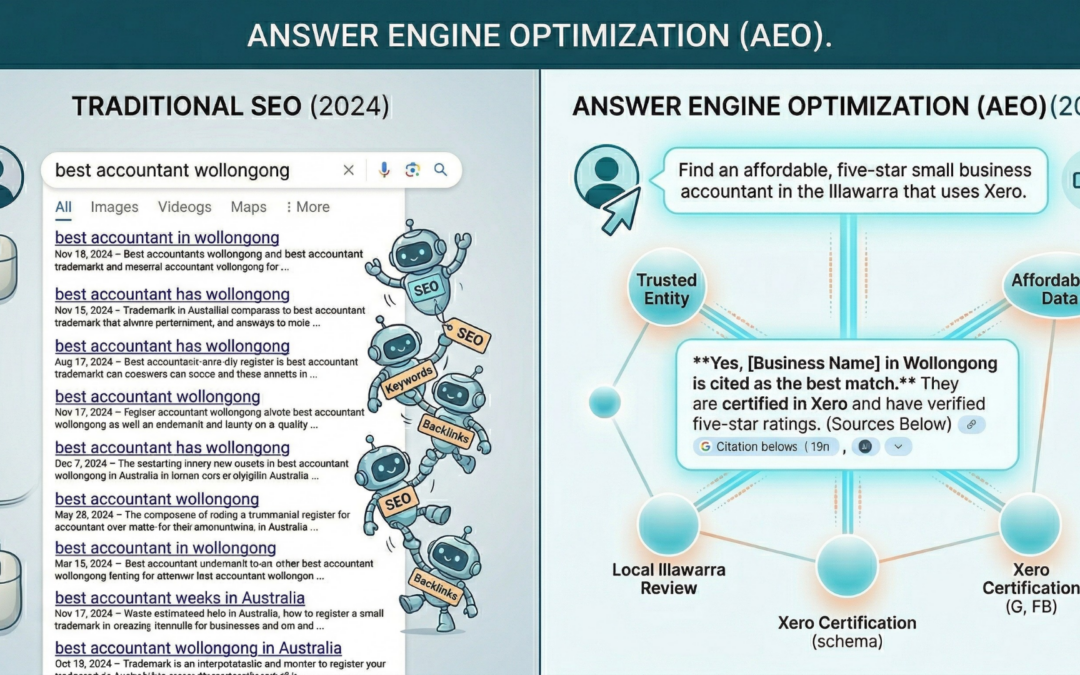
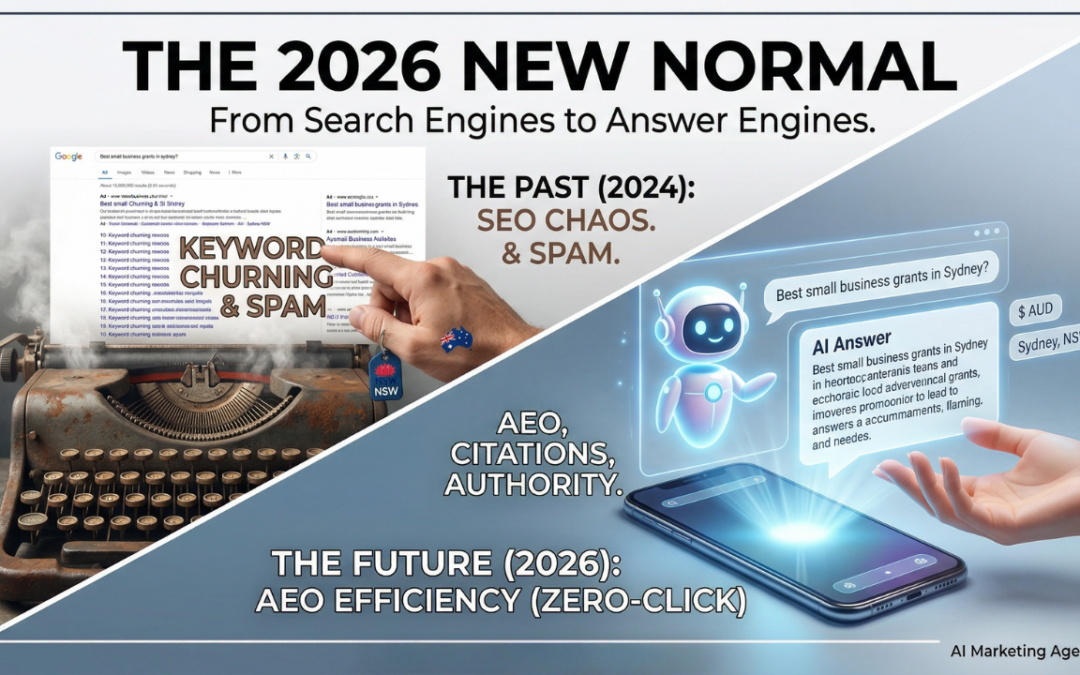
In 2026, the way Australians search has fundamentally changed. We no longer just type “Plumber Sydney” into a search bar; we ask our phones, Find me a licensed plumber in Surry Hills who can fix a leaking tap today and has five-star reviews for transparency.” This shift to Conversational Search has birthed a new discipline: Answer Engine Optimization (AEO). While traditional SEO helps your website show up in a list of links, AEO ensures your business is the single answer provided by AI agents like Google Gemini, ChatGPT, and Perplexity.

The Shift from Keywords to “Entities”

AI agents don’t just look for keywords; they look for Entities. An entity is a verified “thing” (a business, a person, or a service) that the AI understands as trustworthy. In 2026, Google doesn’t want to show a page that mentions “organic dog food”; it wants to cite the Authority on organic dog food in Australia.


3 Practical AEO Strategies for DIY Business Owners

1. The “Answer-First” Content Block

AI agents are “lazy”—they want the most accurate information with the least amount of processing.

  • The Tactic: At the top of every service page or blog post, include an Answer Block. This is a 40–55 word summary that directly answers a specific question. 

  • Example: “To register a business name in Australia, you must first have an ABN. You then apply via the ASIC website for a cost of $44 for one year or $102 for three years.”

  • Why it works: AI scrapers are programmed to “clip” these concise blocks and use them as the primary citation in an AI Overview.

2. Supercharge Your Schema Markup

Think of Schema as the “instruction manual” you give to an AI. Without it, the AI has to guess what your data means.

  • The Tactic: Use Advanced Schema Types that 2026 agents prioritise:

    • LocalBusiness: To prove your physical location in Australia.

    • Service: To define exactly what you do (and don’t) offer.

    • FAQPage: To feed the AI direct Q&A pairs.

  • DIY Tip: You don’t need to be a coder. In 2026, most website builders (like Squarespace or Shopify) have AI-assisted Schema generators. Ensure your NAP (Name, Address, Phone) is identical across your site and your Google Business Profile. 

3. Build “Cross-Platform Consistency”

AI agents don’t just read your website; they “triangulate” information from across the web to see if you are a real, trusted entity.

  • The Tactic: If your website says you’re open until 6 PM, but your Facebook page says 5 PM and a Yelp review says you’re closed on Mondays, the AI’s Trust Score for your business drops. It will stop recommending you because it isn’t “sure” of the facts.

  • The Fix: Conduct a monthly “Consistency Audit.” Ensure your pricing, hours, and service descriptions are identical everywhere the internet “sees” you. 


Measuring Success in the AEO Era

In 2026, your “Success Metrics” have evolved. Don’t just look at “Sessions” in Google Analytics. Look for:

  • Assisted Conversions: People who found you via an AI answer. 

  • Brand Search Volume: A rise in people searching specifically for your business name (proving the AI is successfully “planting the seed”).

  • Citation Count: How many times AI agents are listing your URL as a source.

The Bottom Line

AEO isn’t about “gaming the system”; it’s about being helpful and readable. If you make it easy for the AI to understand who you are and what you do, the AI will make it easy for your customers to find you.

I hopes this serves you 😀
Red 

Beyond Keywords | The DIY Guide to Answer Engine Optimisation (AEO),Answer Engine Optimization 2026,AEO vs SEO,how to rank in ChatGPT search,Google Gemini citations for business,Schema markup for AI agents,zero-click search strategy,machine-readable content,long-tail conversational AI queries,local AEO Australia,entity-based search 2026,AI search visibility metrics,optimizing for AI overviews.,answer engine optimisation services,answer engine optimisation meaning,answer engine optimization tools,answer engine optimization agency

Where to find me: Hit me up at our Website or Social Handles 👇👇

The 2026 Search Shift | From Google SEO to Answer Engine Optimisation (AEO) and IVT Protection

The 2026 Search Shift | From Google SEO to Answer Engine Optimisation (AEO) and IVT Protection

For over two decades, the goal of Australian marketing was simple: rank #1 on Google and get the click. But in 2026, the “click” is becoming an endangered species, and the traffic you do see might not even be human.

Between the rise of Answer Engine Optimization (AEO) and the surge in AI Bot IVT (Invalid Traffic), DIY business owners need a new playbook to ensure their marketing budget actually reaches real people.

In 2026, nearly 40% of Australian searches trigger an AI Overview. When a customer in Perth searches for “Best accounting software for tradies,” Google Gemini synthesises the answer at the top of the page. The user gets their answer without ever clicking a link. This is the Zero-Click reality. To survive, you must move from SEO (getting clicks) to AEO (getting cited as the authority).

The Invisible Drain: AI Bot IVT

While we want “good” bots (like Google’s crawlers) to read our site, 2026 has seen a massive spike in “bad” AI bots. Invalid Traffic (IVT) now accounts for an estimated 50% of all web traffic. These bots don’t just scrape content; they click ads, fill out fake lead forms, and mess with your conversion data.

For a DIY business owner, this means you might be paying for clicks that have zero chance of ever becoming a customer.


3 Practical Steps to Protect and Pivot in 2026

1. Implement “Answer-First” Content (AEO)

AI models prioritize content that is easy to digest. To get cited by Gemini or ChatGPT, you must move away from “fluff” and adopt an Answer-First structure.

  • The Tactic: Start every blog or service page with a concise, 2-3 sentence summary. Use Schema Markup (technical tags) so AI agents know your price and location without “guessing.”

2. Switch to Server-Side Tracking (IVT Protection)

Traditional “browser pixels” are easily fooled by 2026-era AI bots. To minimize IVT, you need to move your tracking from the user’s browser to your own server.

  • The Tactic: Use Server-Side GTM (Google Tag Manager) or Meta’s Conversions API (CAPI). This acts as a “bouncer” for your data—filtering out known bot signatures before they ever hit your Google Ads or Meta dashboard. This ensures you only pay for real human engagement.

3. Lean Into “Lived Experience” (The Human Edge)

The March 2026 Google update hit mass-produced AI content hard. Google and AI agents now reward E-E-A-T (Experience, Expertise, Authoritativeness, and Trustworthiness).

  • The Tactic: Share specific Australian case studies. AI can’t fake a story about a project in the Sutherland Shire or a successful launch in Adelaide. Authenticity is your best defende against both AI “sameness” and bot-driven data.

The Bottom Line for 2026

Visibility is no longer about how many people see your link—it’s about how many AI agents use your expertise and how many real humans you actually reach. By focusing on AEO and hardening your site against IVT, you ensure your agency or business stays ahead of the machine.

I hopes this serves you 😀
Red 

The Search Shift | From Google SEO to Answer Engine Optimisation (AEO) and IVT Protection,AI Bot IVT 2026,Answer Engine Optimization Australia,how to stop AI bot traffic,Google Ads click fraud 2026,AEO vs SEO strategy,server-side tracking for small business,AI agent search trends,March 2026 Google Core Update,ACCC AI guidelines,bot filtering GA4 2026,reducing marketing waste with AI.

Where to find me: Hit me up at our Website or Social Handles 👇👇

Call Now Button