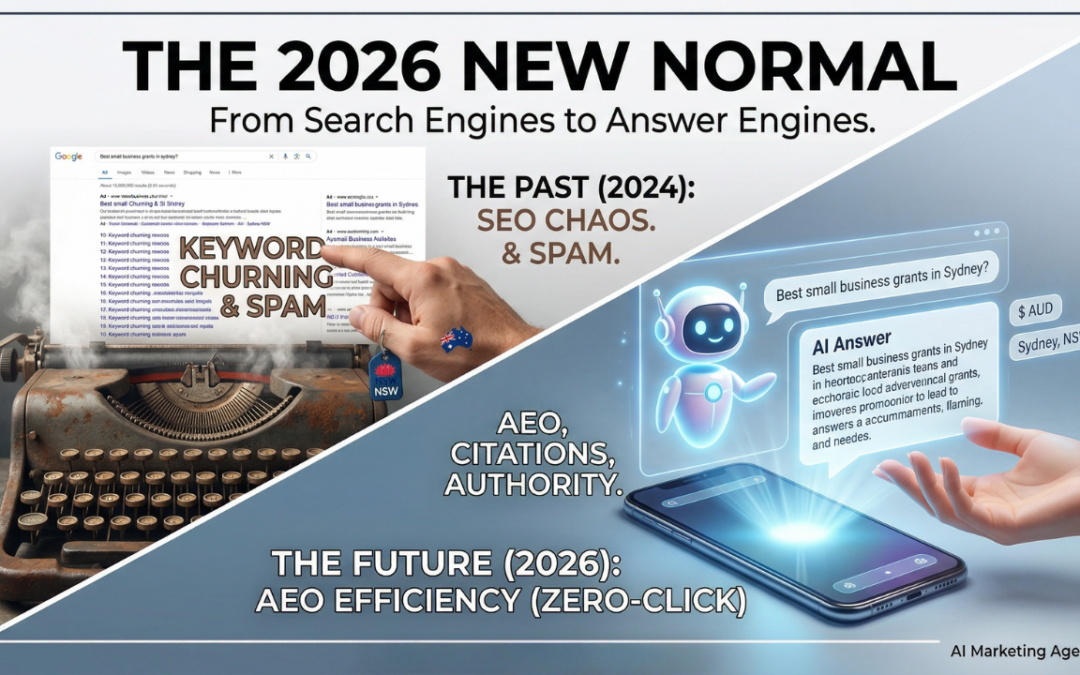
For over two decades, the goal of Australian marketing was simple: rank #1 on Google and get the click. But in 2026, the “click” is becoming an endangered species, and the traffic you do see might not even be human.
Between the rise of Answer Engine Optimization (AEO) and the surge in AI Bot IVT (Invalid Traffic), DIY business owners need a new playbook to ensure their marketing budget actually reaches real people.
The Rise of the “Zero-Click” Search
In 2026, nearly 40% of Australian searches trigger an AI Overview. When a customer in Perth searches for “Best accounting software for tradies,” Google Gemini synthesises the answer at the top of the page. The user gets their answer without ever clicking a link. This is the Zero-Click reality. To survive, you must move from SEO (getting clicks) to AEO (getting cited as the authority).
The Invisible Drain: AI Bot IVT
While we want “good” bots (like Google’s crawlers) to read our site, 2026 has seen a massive spike in “bad” AI bots. Invalid Traffic (IVT) now accounts for an estimated 50% of all web traffic. These bots don’t just scrape content; they click ads, fill out fake lead forms, and mess with your conversion data.
For a DIY business owner, this means you might be paying for clicks that have zero chance of ever becoming a customer.
3 Practical Steps to Protect and Pivot in 2026
1. Implement “Answer-First” Content (AEO)
AI models prioritize content that is easy to digest. To get cited by Gemini or ChatGPT, you must move away from “fluff” and adopt an Answer-First structure.
-
The Tactic: Start every blog or service page with a concise, 2-3 sentence summary. Use Schema Markup (technical tags) so AI agents know your price and location without “guessing.”
2. Switch to Server-Side Tracking (IVT Protection)
Traditional “browser pixels” are easily fooled by 2026-era AI bots.
-
The Tactic: Use Server-Side GTM (Google Tag Manager) or Meta’s Conversions API (CAPI).
This acts as a “bouncer” for your data—filtering out known bot signatures before they ever hit your Google Ads or Meta dashboard. This ensures you only pay for real human engagement.
3. Lean Into “Lived Experience” (The Human Edge)
The March 2026 Google update hit mass-produced AI content hard. Google and AI agents now reward E-E-A-T (Experience, Expertise, Authoritativeness, and Trustworthiness).
-
The Tactic: Share specific Australian case studies. AI can’t fake a story about a project in the Sutherland Shire or a successful launch in Adelaide. Authenticity is your best defende against both AI “sameness” and bot-driven data.
The Bottom Line for 2026
Visibility is no longer about how many people see your link—it’s about how many AI agents use your expertise and how many real humans you actually reach. By focusing on AEO and hardening your site against IVT, you ensure your agency or business stays ahead of the machine.