
Free Marketing Toolkit Opt-in
(02) 42444411 info@ybrmarketing.com.au
Website Design Wollongong – How Much Does It Cost?

Website Design Wollongong – How Much Does It Cost?

It’s safe to say your business will only grow if you have a website. Most small businesses don’t realize how important a website is until it’s too late. Don’t fall into this trap. Your website should be one of, if not, the most important tools in your business arsenal. It’s easy to fall for the lie that “I don’t need a website because my business is small now and will stay small in the future”. This is far from the truth. And no, it doesn’t matter what industry you are in or how big or small your company may be. If you are in business, you need a professional designed site that will help build credibility, create opportunities and improve the overall image of your company to customers online.

A website is an essential tool for any business. 

Ensure that your website looks exactly how you envision it. You can choose between a simple one-page website or a more complex multi-page website.

A well designed website is essential if you want to succeed online. If you are thinking about starting a business, then you should consider having a professionally designed website. The best websites are those that look attractive and are easy to navigate. Websites that are poorly designed can be very frustrating for visitors.

Create a professional looking site that will attract new clients and keep existing ones coming back.

When designing a website, there are many things to think about. You must decide what type of content you want to include on your website. There are several different types of content available such as text, images, video, audio, etc. Once you have decided which type of content you would like to use, you must choose a web host. Web hosting refers to the place where your website resides. There are many different companies offering web hosting services. Some of them offer free web hosting while others charge monthly fees. After choosing a web host, you must register your domain name. Domain names are unique identifiers used to identify websites. For example, www.example.com is a domain name. You must purchase a domain name from a company that offers domain registration. Finally, you must install a web page builder software program onto your computer. A web page builder allows you to easily add pages to your website without needing to know HTML code.

Choose a Theme.

We use WordPress as our CMS platform because it offers a lot of flexibility and power. If you need help choosing a theme, we recommend starting with these popular themes.

Themes are what makes WordPress unique. You can choose from hundreds of free and premium themes available online. There are many different types of themes, such as blog themes, magazine themes, eCommerce themes, etc. Each type has its own set of features and benefits. For example, some themes offer drag-and-drop page builders, while others allow you to customize every aspect of your site. Some themes are mobile responsive, while others are not. Some themes are SEO optimized, while others are not (yet).

Customize it

We know what you’re thinking.

You want a website that looks great and is easy to manage. You probably want it to be mobile-friendly, too. And you definitely need it to work well with SEO—or at least look like it does.

But you don’t want to pay for all that.

Well, we’ve got the answer for you. We’ll create a site that’s perfect for your business using WordPress and our custom theme builder, which means you can easily make changes yourself whenever you need to. Plus, we’ll optimize your site for speed and search engines so that it performs well in Google searches—saving you time and money on SEO costs.

Add features like contact forms or eCommerce.

If you want to create a website that will help you grow your business, it’s important to include features like contact forms, blogs, galleries, eCommerce, and more. These tools allow visitors to communicate with you directly, share content, and purchase products. In addition, many of these features are free to use—which means you won’t have to pay extra fees to add them to your site.

The best websites include these tools because they allow visitors to engage with the brand in a meaningful way. They also make it easy for visitors to share content and buy products without leaving the site or having any technical knowledge about how websites work.

Upload images and videos.

Images and videos add life to your website. It’s not just the words you use that can make your site more visually appealing, it’s the images and videos you add to it as well.

Images and videos are powerful tools for creating a captivating user experience. They are also valuable tools for converting visitors into customers. They help people feel like they know you, understand what your business does and how it works, and even how it can help them solve their problems.

Key Factors for Website Costs

After you have determined what type of website you want to create, it’s time to figure out how much it will cost. Website design costs can vary depending on the type, size, and complexity of your site.

The process of designing a website can be broken down into three parts: content, design and development. Content is what you put on your site, such as text and images. Design refers to the way your site looks (for example, its color scheme). Development is how your website functions (for example, whether it has an online store or not).

As you can see, there are a lot of factors that come into play when you’re trying to determine your site’s design cost. Everything from the complexity of the site to the tools, technologies and hosting services you need to use can have an effect on your price. Through our own experience building websites over many years, as well as watching thousands of websites get built by customers using popular website builders, we’ve developed some general guidelines for estimating your website design price based on the type of site you want.
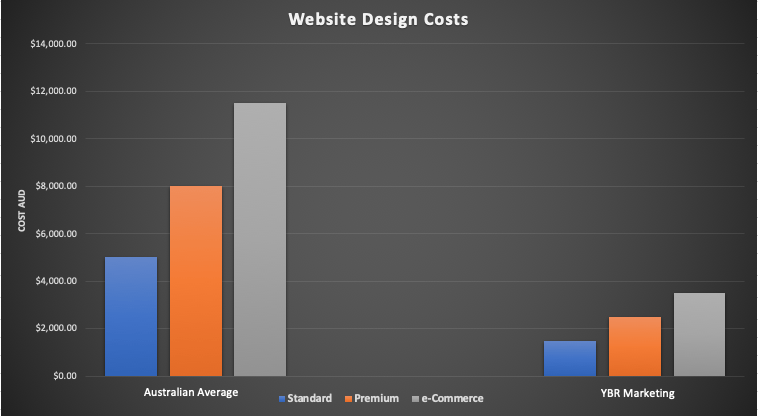
website design costs comparison

Resource: Australian average website design costs – IBISWorld

For most businesses, a website design is the most important marketing tool you have. A professional website is no longer an option. It’s critical to success.

Our website design costs have never been lower. We have website plans to suit any business type..

To Your Marketing Success

John

wollongong digital marketing

The Power of Your Business Hub a.k.a. Website

The Power of Your Business Hub a.k.a. Website

Your website is a powerful 24/7 marketing tool.

The digital age offers us all a dizzying array of choices. You have to sift through millions of web pages and navigate different mobile apps to find the information you need. But your business needs a hub – an online center (or origin) for the digital activities that promote your brand across all channels. I call this your “digital home.” Think of it as a place that makes people want to come back by providing high-quality content and acting as a trustworthy resource for your audience. All this will work together to build your online identity and enhance your brand awareness.

What are the 5 key purposes of a website?

Websites serve five main functions:

1) Provide information

One of the key purposes of your business website is to help you grow your business. To do that, you need to make sure you’re doing everything possible to promote yourself online. That means having a website that’s optimized for search engines, social media, email, and more. 

Creating an online presence is essential for any company looking to expand its customer base and grow its brand awareness. A well-designed and strategically-managed website is the foundation for any digital marketing strategy. It can be used to attract customers by providing them with valuable content on your products or services, as well as build trust among consumers by providing transparent information about your business practices.

By implementing these strategies into your digital marketing plan, you will see results faster than ever before!

2) Sell products and services

Selling products and services online is a great way to reach a wider audience.

When you’re selling online, it’s important to make sure you have all the tools and resources you need to promote yourself effectively.

A website is a great place to start. Not only does it give you a platform to showcase your products, but it also helps with search engine optimization (SEO).

3) Engage visitors

If you’re looking to engage visitors, you need to make sure you’re doing everything possible to promote yourself online.

The main way to engage visitors is through SEO. SEO stands for “search engine optimisation,” and it refers to the process of making your website more appealing to search engines like Google, Bing and Yahoo so that they’ll show your page when someone searches for terms related to what you do.

“Perform an on-page SEO audit on a page”

4) Collect contact details

If you’re looking to collect contact details, you need to make sure you’re website is designed to attract and inform.

You can improve your website’s ability to collect information about visitors by adding a phone number or email address in the footer. You can also use newsletter signup forms and social media buttons that allow people to connect with you on their favorite platforms.

If you want to grow your business and increase sales, it’s important that your site has an easy way for people interested in your products or services to contact you.

5) Build trust

One of the primary purposes of a business website is to build trust. You want to attract customers by providing useful information, and you want to make sure your site is designed in such a way that it’s easy for people to find the information they need.

This is especially important if your business is not well-known in the industry. By providing useful, verifiable information about your company and its products, you’ll help potential customers feel more confident about working with you.

Building a Strong Online Presence.

Your website hub is an extension of your brand that helps you manage your entire digital presence. It includes everything from your social media profiles to your email list.

Creating a strong online presence will help you grow your business and build loyalty among existing customers. Your website hub should give visitors a sense of who you are as a brand and what they can expect from interacting with you online.

Manage All Digital Marketing Efforts.

The easiest way to improve your digital marketing skills is to create a website!

If you’re looking to grow your business, then you need to make sure that every aspect of your digital marketing efforts is managed through one place.

A website is a central location where you can manage all of your online marketing efforts. You can use a website to create new content, upload images, schedule social media posts, and much more.

If you’re looking to improve your digital marketing skills, then you should consider creating a website. A website is a centralized location where you can manage your entire digital marketing strategy. You can use a site hub to create new content (like blog posts), upload images, schedule social posts, and much more – all from one place.

Remember, a website is more than just a collection of pages. It needs to add value for its visitors, tell your story in the best way possible, and keep people coming back for more.

Building Your Own Hub

When it comes down to it, you need to be keenly aware of your needs and goals. If you have a very specific design in mind, then WordPress may seem like a good option, as you’ll have complete control over the final product. On the other hand, if all you’re looking for is an easy-to-navigate site with a few pages, then a simple website builder might be best. In short, do your homework before making a choice. You never want to discover too late that you or your web designer made an irrevocable mistake by building your site on the wrong platform.

If you’d like to create your own website, it might be easiest to start with an all-in-one building service like Squarespace, Weebly, or Wix. These services make it possible for you to build a site without knowing anything about code.

Have a website but it’s not showing the results you need?

If you have created your own business website, but it’s not showing the results you need?

Your website is the face of your business and it needs to work for you.

You might be suffering from a lack of traffic.

If you have invested in paid advertising, but that’s not working either?

You might be suffering from a lack of quality content.

If you have created both high-quality content and paid advertising, but your website is still not getting enough traffic?

Your website might look a little amateurish?

Then… you might be suffering from a lack of website optimisation or in need of a simple website makeover..

As a business, your website serves as your digital hub. It’s where you can showcase who you are, what you do, and how you can help others. Your website holds all the information that your customers and clients need to know and trust in order to do business with you. But if you’re not using it to its full potential, then it might be time for a website makeover. Ask yourself: are you providing helpful information to your audience? Are you making it easy for people to find what they need? Are people visiting your page because they’re looking directly for what you offer? There should be an increase in traffic and time on page, ideally leading to an increase in conversions.

Having an online presence that showcases who you are as a brand, is made through the power of your business information hub aka website, so you can ask yourself the question? What is the online future of my business? With a business hub, the future can be very bright!

Dedicated To Your Marketing Success

John

wollongong digital marketing

How To Make Your Ad Campaign More Effective Over Time

How To Make Your Ad Campaign More Effective Over Time

Google AdWords has been around for many years now, and there are lots of people that use this platform to promote their business. The question is, how long will your ad stay on top of the search results?

Here’s how to make it happen.

If you’re using Google AdWords, then you probably know that you need to set up an account with them. Creating a Google Ads Account”

Once you’ve done that, you’ll need to decide what type of advertisement you’d like to run. There are two main options: text ads and display ads. Text ads are basically just words that appear at the top of the page, while display ads are images that show up when users scroll down the page.

Create an effective ad group.

After you’ve decided which kind of ad you want to use, you’ll need to choose where you want to place it. This decision will depend on how much money you want to spend. Display ads cost more than text ads because they take up more space on the screen. However, they also tend to generate higher click through rates (CTRs). So, if you’re looking to make the most out of your budget, then display ads might be the way to go.

Set up your keywords.

Once you’ve chosen an ad type, you’ll need to decide what words you want to show up when people search for those terms. These are called keywords. If you’re using paid advertising, you’ll need to set up keywords before you start running campaigns. You can do this by going to the “Keywords” tab in the “Ad group settings.”

(“SEO Keyword Research and Mapping”)

Choose your bid strategy.

There are two main strategies for bidding on keywords: cost per click (CPC) and cost per impression (CPI). CPC bids are based on how much advertisers are willing to pay for each click on their ads. CPI bids are based on how often users see your ads.

Test your campaigns.

If you’re not seeing results after a few weeks, try testing different ad groups, ad copy, and landing pages. (“How to Create a Lead Generation Landing Page”)

Also consider changing your bid strategy.

(“Reasons Why Your Google Ads Don’t Work & How To Fix ’em”)

So there you have it, if you’re thinking of starting a Google Ads campaign and you want it to stay up at the top of the results, then remember these steps. In time, your ad will reach the first page and stay there. Besides, who doesn’t want to be advertising on the first page of Google? Well what are you waiting for? Get started!

Go to our “Free Tools” for more resources from professional  standard SOPs to free software apps that can really boost your marketing without draining your wallet..

Dedicated to your marketing success

John

wollongong digital marketing

What Are Marketing Controls?

What Are Marketing Controls?

An Overview of Marketing Controls

Advertising is an important part of any business, but it can also be tricky. The goal of advertising is to reach the right audience at the right time, so marketers use various techniques to control how consumers view their advertisements.

One way they do this is by using marketing controls. Marketing controls are simply methods used by marketers to control how consumers interact with advertising campaigns. They can be as simple as choosing what colors to use in an advertisement or as complicated as deciding which channels to advertise on. In this guide, we’ll go over some common marketing controls and how you can use them to improve your own advertising efforts!

Ad Extensions

You know what they say: the more you know, the less you show.

And that’s where extensions come in. One of the most common ways to control who sees your ad is through extensions. These are small pieces of code that appear alongside your ad. They allow you to customize your ad based on where it appears. For example, if you only want your ad to be shown on a certain kind of website—say, news sites—you can set up an extension that will display only when someone visits one of those sites.

Google Ad extension tool

Dynamic Remarketing Lists.

Dynamic Remarketing Lists are another way to control who sees your ads. If you use Google AdWords, you can create a list of users who visited your website and then add those users to an ad campaign. You can also create a list of people who have visited certain pages on your site or added certain products to their cart but didn’t complete the purchase.

This type of targeting allows you to show ads to users who have shown interest in your product or service but haven’t bought it yet. This helps you increase sales without wasting money showing ads to people who don’t care about what you’re selling!

Targeting Options.

You can also target users based on their location, device type, and other criteria. For example, you might only show ads to users who live within a certain radius of your business. Or you might only show ads on mobile devices.

You can also target users based on their interests and demographic information. This is particularly useful for targeting customers who are likely to be interested in what you’re selling. It is a great way to help cut down on costs while still getting the most out of your ads!

Display Network Ads.

If you use Google AdWords, you can choose to display your ads on websites across the web. This is called the Display Network. It includes sites such as Facebook, Twitter, LinkedIn, and Pinterest.

The Display Network is a great place to reach people who are actively searching for solutions to their problems. These people will be focused on their search and are therefore more likely to notice your ads.

You can also target specific groups of people who have an interest in what you offer. For example, if you sell products for pets, you could target pet owners by setting up campaigns that show only when someone searches for an animal-related query on Google or Bing.

Audience Segmentation.

You can also choose to limit who sees your ads by using the Display Network. This allows you to control where your ads appear based on the type of site visitors you want to reach. For example, you might only want to show your ad to users who visit certain pages on your website.

This way, you can make sure that people who visit your homepage don’t see an ad for a product that is only available on a more specific page of your site. This is called audience segmentation and it helps you improve the relevance of your campaign.

Hopefully, you now have a better understanding of marketing controls. There are many more in-depth resources available online that can give you even more information about the specific methods and techniques highlighted here. Remember to always experiment with different marketing controls to see what works best for your business and how you can adapt your advertising efforts accordingly.

Need answers om how to implement these controls or any other aspect of your makrketing efforts, please let me know, and I’ll be happy to help you out!

To Your Marketing Success

John

wollongong digital marketing


Free Resources Here.. or click on the images and links in the sidebar of this post ➡️➡️

What’s Your Unique Selling Position?

What’s Your Unique Selling Position?

Get Out Of The Commodity Business By Developing A Unique Selling Proposition

You know you’re marketing your business as a commodity when prospects start the conversation by asking you about price.

Positioning yourself as a commodity and hence being shopped on price alone is a terrible position for a small business owner to be in. It’s soul crushing and this race to the bottom is bound to end in tears.

The answer is to develop a unique selling proposition (USP). Something that positions you differently, so that prospects are forced to make and apples-to-oranges comparison when comparing you with your competitor.

If they can do an apples-to-apples comparison of you and your competitors then it comes down to price and you’re toast, because there’s always someone willing to sell cheaper than you.

There’s Nothing New Under The Sun

Very few if any businesses or products are truly unique, so a common question is, “there’s nothing unique about my business, how do I develop a USP?”.

There’s no quick and simple answer to that question but here are a few ideas.

Firstly we want to get into the mind of our prospect. What do they really want? It’s rarely the thing you are selling, it’s usually the result of the thing you are selling. The difference may seem subtle but it’s huge.

For example someone buying a $50 watch is buying something very different from a person buying a $50,000 watch. In the latter case they are likely buying status, luxury and exclusivity. Sure they want it to tell the time just like the buyer of the $50 watch but that’s unlikely to be their core motivation.

So to get into the mind of the prospect, we need to discover what result they are actually buying. Once you understand this, you then need to craft your unique selling proposition based on the result your prospects want to achieve.

For example if you’re a printer, you’re a commodity business. You want to get out of the commodity business as quickly as possible. I don’t mean get out of the industry but you do need to change how you position yourself.

Stop selling business cards, letterheads and printing and start asking open ended questions such as, “Why are you coming to a printer? What is it that you want achieve?”. The prospect doesn’t want business cards and letterheads, they want what they think business cards and letterheads are going to do for their business.

So you could sit down with them and and say, “What are you trying to accomplish? Let’s do a printing audit and evaluate all of the things you’re trying to use printing for. By taking them through the process, you can charge them to do a printing audit. Then if they end up hiring you to do their printing, you can apply that consulting fee towards printing. This way you’re no longer viewed as a printer anymore. You’re now viewed as an advisor that’s serving their needs.

Use Outrageous Guarantees

Another great strategy for creating uniqueness in your offer is an outrageous guarantee. One which completely reverses the risk of the transaction.

To be truly unique when using this technique you must avoid the vague crap that everyone says e.g. satisfaction guaranteed, service quality, dependability.

You must have a very specific guarantee to address the fear or uncertainty that the prospect has about the transaction.

For example if you’re in the pest control business you’re customers want to know:

  1. The pests won’t come back
  2. The technician won’t leave their house dirty
  3. That you won’t poison their family with chemicals

So you’re outrageous guarantee could be something like this:

“We guarantee to rid your home of ants forever, without the use of toxic chemicals, while leaving your home in the same clean and tidy condition we found it. If you aren’t absolutely delighted with the service provided, we insist that you tell us and we’ll refund double your money back.”

Compare that to a weak, vague guarantee like, “satisfaction guaranteed”.

Does an outrageous guarantee like the one above entail risk for the pest control service provider? Sure, if they do a crappy job. But in a case like that they’re likely to have to give the customer a refund anyway. It may even be a legal requirement.

Here’s the other thing about guarantees. If you’re an ethical operator, you are most likely already offering a guarantee but you just aren’t using it to your advantage in your marketing.

So why not make a point of talking about something that you’re already doing.

Most people are honest and won’t abuse guarantees if they’ve received the service they were promised.

Even after accounting for the few people who do abuse them, you’ll be far ahead because a strong guarantee will attract more customers than a weak and vague one.

A strong, results oriented guarantee will also drive you to deliver a great customer experience. This alone ensures that it’s worthwhile to have a strong guarantee.

Your customers have their own fears. When you can name the fears and guarantee
against them in your marketing, you give yourself an overwhelming advantage
over your competitors.

Pricing Strategy

I’m sometimes asked, “can’t lowest price be my USP?”. Sure it can, but can you absolutely guarantee that everything you sell will be priced lower than all your competitors including the behemoths like Target and Kmart? Unlikely.

So a USP that says “lowest prices on some things, some of the time” is not quite so compelling.

The fact is if you’re a small or medium business, you’re unlikely to beat the big discounters at the lowest price game.

Truth be told, you probably don’t want to. By charging higher prices, you attract a better quality client. As counter intuitive as it may seem, you get far less grief from high end customers than you do from low end ones. I’ve seen and experienced this in multiple businesses across multiple industries.

A better option than discounting is to increase the value of your offering.

Bundling in bonuses, adding services, customising the solution can all be of genuine value to your customer but can cost you very little to do.

This also helps you create that apples-to-oranges comparison that gets you out of the commodity game.

Don’t hate the player, hate the game. So as hard as it may be to resist, don’t play the commodity/price game.

Dedicated To Your Marketing Success

John

wollongong digital marketing

“I would like to acknowledge the wonderful Alan Dib from Successwise

Call Now Button